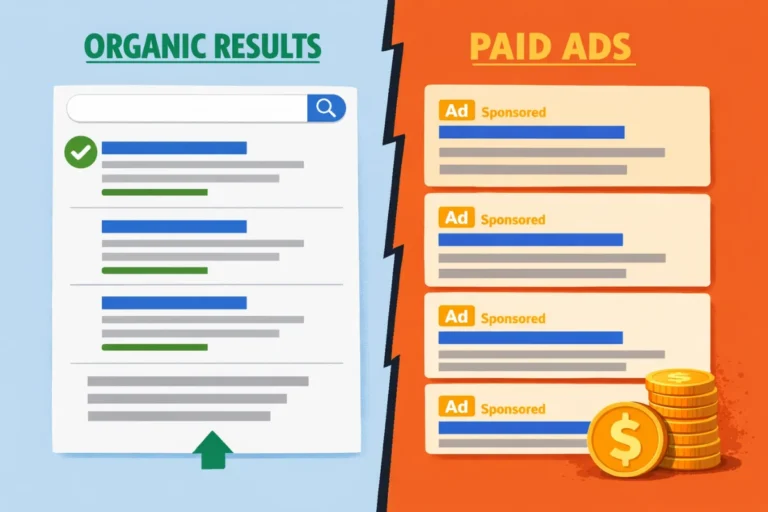


Contractor SEO and regular SEO are often treated as interchangeable, but they operate under very different constraints. While both aim to improve search visibility, the way search engines evaluate contractors is shaped by local intent, buyer urgency, and trust validation in ways that do not apply to most general websites. This distinction is why strategies that succeed in traditional SEO often underperform when applied to contractors.
In Texas service markets like Dallas, contractor SEO is evaluated through proximity, credibility, and service relevance rather than broad topical coverage. Search engines must decide which contractor to show for a high-intent search where the user is ready to call, not research. That decision relies on different signals than those used for informational or national search queries.
This article explains what makes contractor SEO different from regular SEO (contractor seo vs regular seo) by examining the structural, behavioral, and competitive differences between the two. Instead of focusing on tactics, it compares how search engines interpret intent, geography, authority, and success across these distinct SEO models.
Table of Contents
Why Is Contractor SEO Built Around Buyer Intent While Regular SEO Is Not?
Contractor SEO is evaluated primarily through buyer readiness, not information consumption. When someone searches for a contractor, the intent is often immediate and transactional. Search engines interpret these searches as service requests rather than research, which changes how relevance and rankings are determined.
Regular SEO, by contrast, is often designed around informational depth and topic exploration. Pages can rank by providing broad explanations, comparisons, or long-form content without a clear path to conversion. Contractor SEO does not benefit from this model because search engines must surface businesses that can satisfy an immediate need within a specific location.
In competitive markets like Houston, this difference becomes more pronounced. Contractor SEO must align services, locations, and trust signals tightly to match urgent intent. Regular SEO can afford broader interpretation, but contractor SEO is judged on how quickly and confidently it can connect a searcher to a real business ready to respond.
How Does Geographic Dependency Make Contractor SEO Fundamentally Different?
Geography is optional in regular SEO but foundational in contractor SEO. Search engines must determine not only whether a page is relevant, but whether the business can realistically serve the searcher’s location. This makes proximity, service-area clarity, and local relevance signals central ranking factors for contractors.
Regular SEO can succeed without precise geographic alignment. A blog, software company, or national brand can rank broadly by satisfying topic relevance alone. Contractor SEO cannot. Visibility is constrained by distance, competition within that radius, and how clearly a contractor communicates where services are actually delivered.
In markets like Austin, geographic dependency intensifies competition because multiple contractors target overlapping neighborhoods and service zones. Search engines respond by prioritizing businesses with the clearest and most consistent local signals. This dependency makes contractor SEO more fragile, more localized, and fundamentally different from regular SEO in how rankings are earned and maintained.
Why Trust Signals Matter More in Contractor SEO Than Regular SEO
Trust plays a central role in contractor SEO because search engines are recommending a real business to solve a real problem, often under time pressure. The risk of a poor outcome is higher than with informational content, so search engines rely heavily on credibility indicators to reduce uncertainty.
Regular SEO can perform well with limited external validation as long as content quality and relevance are strong. Contractor SEO requires additional confirmation through business legitimacy, reputation signals, and consistency across the web. Without these elements, even well-optimized pages struggle to sustain visibility.
For contractors operating in San Antonio, trust signals help search engines distinguish between similar service providers competing for the same demand. Reviews, references, and corroborating mentions reinforce reliability. This reliance on trust makes contractor SEO more sensitive to credibility gaps than regular SEO models.
How Do Competition Models Differ Between Contractor SEO and Regular SEO?
Competition in contractor SEO operates within a constrained, high-pressure environment that does not exist in regular SEO. Search engines are not choosing between thousands of pages globally; they are choosing between a limited number of businesses that can realistically serve a specific location. This makes contractor SEO a comparative ranking system, where businesses are judged directly against one another rather than against abstract content quality alone.
In regular SEO, competition is often topic-based. Pages compete on content depth, topical coverage, and information usefulness, and rankings can coexist across many results. A website can rank well even if competitors are stronger in certain areas, as long as it satisfies a distinct informational angle. Contractor SEO does not allow this flexibility. Visibility is scarce, and search engines must filter aggressively to select only a few businesses for high-intent results.
For contractor SEO, competition is shaped by local density, service overlap, and trust differentiation. Multiple contractors may offer identical services within the same radius, forcing search engines to rely on subtle signals to determine preference. These include proximity, reputation strength, and signal consistency across platforms. Because of this, small competitive advantages compound quickly, while small weaknesses lead to exclusion rather than partial visibility.
In Dallas, where many contractors compete within the same neighborhoods, this model becomes especially unforgiving. Regular SEO might tolerate slower content updates or weaker authority if the page still satisfies intent. Contractor SEO does not. Competition is direct, localized, and zero-sum, which fundamentally changes how rankings are earned, defended, and lost.
Why Contractor SEO Is Measured by Leads While Regular SEO Is Measured by Traffic
Contractor SEO is evaluated by lead generation, not by traffic volume, because search intent is transactional rather than exploratory. When someone searches for a contractor, the expectation is to contact a business, request a quote, or schedule service. Search engines account for this by prioritizing results that historically convert visibility into real-world action.
Regular SEO is often measured by traffic growth, engagement time, or content reach because many searches are informational. A page can succeed by educating, comparing, or answering questions without requiring the visitor to take immediate action. In contractor SEO, traffic without conversion is treated as misalignment rather than success.
This difference affects how performance is interpreted. Contractor SEO focuses on whether visibility produces qualified inquiries (calls, form submissions, booking requests) rather than raw visits. Search engines observe user behavior signals such as click-through behavior, repeat searches, and interaction outcomes to infer whether results satisfied intent. When users frequently return to search results or choose competing businesses, rankings adjust accordingly.
In markets like Houston, this distinction becomes critical. High traffic from broad or irrelevant searches does not strengthen contractor SEO performance and can actually weaken relevance signals. Search engines favor contractors whose visibility consistently results in completed actions, reinforcing the idea that contractor SEO success is defined by outcomes, not exposure.
Structural and Search-Behavior Forces That Separate Contractor SEO From Regular SEO
The difference between contractor SEO and regular SEO is not a matter of strategy preference. It comes from how search engines interpret risk, intent, and real-world consequences when presenting results. Contractor searches often lead to immediate action, which forces search engines to apply stricter evaluation standards than they do for general informational content.
Is contractor SEO just local SEO with a different name?
Contractor SEO includes local SEO, but it operates under additional constraints. Local SEO (search optimization tied to geographic relevance) focuses on proximity and location signals, while contractor SEO also weighs service credibility, business legitimacy, and conversion reliability. This layered evaluation makes contractor SEO more restrictive than standard local optimization.
Can regular SEO strategies work for contractor SEO?
Regular SEO strategies can support contractor SEO, but they rarely succeed on their own. Techniques designed for content discovery or national visibility do not address buyer urgency or service readiness, which are central to contractor searches. Without adaptation, regular SEO approaches often generate visibility without meaningful outcomes.
Why does contractor SEO take longer to stabilize than regular SEO?
Contractor SEO takes longer to stabilize because trust signals are accumulated over time. Search engines need repeated confirmation that a contractor consistently satisfies search intent, especially for high-risk services. This validation process is slower than ranking informational content, which can succeed based on relevance alone.
Does contractor SEO change more often than regular SEO?
Contractor SEO changes more frequently because it is sensitive to competition movement, review activity, and local demand shifts. Even when a contractor’s website remains unchanged, external factors alter comparative rankings. Regular SEO is more insulated from these fluctuations due to its broader evaluation criteria.
What the Difference Between Contractor SEO and Regular SEO Really Means in Texas Markets
The difference between contractor SEO and regular SEO lies in how visibility is earned and defended. Contractor SEO is judged through immediacy, locality, and trust, while regular SEO is judged through relevance and informational value. These systems reward different behaviors and punish different weaknesses.
In Texas markets, where contractor competition is dense and service overlap is common, this distinction becomes more pronounced. Search engines must make confident decisions about which businesses to surface for urgent, high-intent searches. Contractor SEO succeeds when it consistently reinforces credibility, relevance, and real-world outcomes over time.
Understanding this difference helps explain why applying regular SEO expectations to contractor SEO often leads to frustration. Contractor SEO is not harder—it is more constrained. When those constraints are respected, visibility becomes durable. When they are ignored, results appear unstable even when effort is high.