
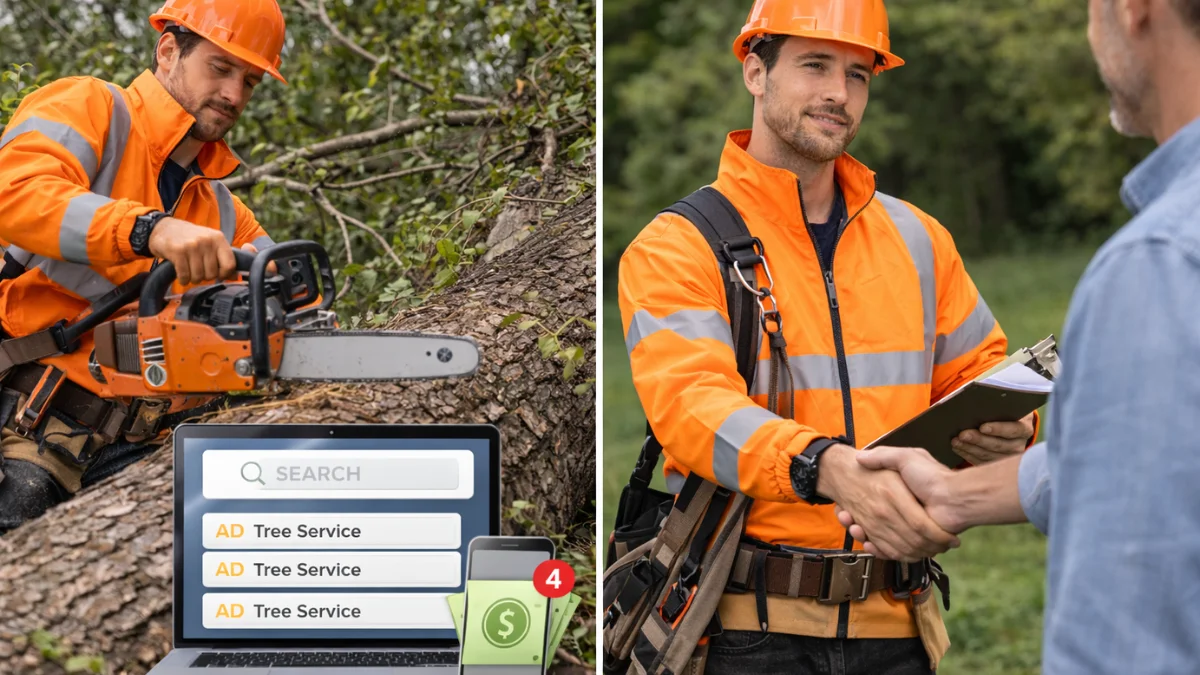

Local map rankings determine which tree service contractors receive the highest volume of calls from nearby homeowners searching for immediate or local services. Visibility in Google Maps is driven by proximity, relevance, and prominence signals rather than traditional organic ranking factors alone.
For tree service businesses, map visibility is closely tied to Google Business Profile optimization, review credibility, service area configuration, and local authority signals. In competitive and storm-prone markets, including many areas of Texas, map rankings often decide which contractors capture urgent demand.
This document explains how tree service contractors win local map rankings by analyzing how Google Maps functions, which signals influence placement, and how contractors compete within crowded map packs. Each section processes a specific local ranking mechanism to clarify how visibility is earned and maintained.
How Do Local Map Rankings Work for Tree Service Contractors?
Local map rankings for tree service contractors are determined by Google’s local search algorithm, which evaluates proximity, relevance, and prominence to decide which businesses appear in the map pack. These rankings operate independently from traditional organic search results.
When a homeowner searches for tree services, Google first assesses geographic proximity between the searcher and available businesses. Results are then filtered by service relevance based on business categories, services, and profile data.
Prominence signals influence final placement. These include review volume, review consistency, brand mentions, and overall local authority. Contractors with stronger trust signals appear more frequently in top map positions.
Map rankings update dynamically. Search location, competition density, and local activity levels cause results to shift, making sustained optimization necessary for consistent visibility.
What Factors Influence Google Maps Rankings for Tree Services?
Google Maps rankings for tree services are influenced by a combination of proximity signals, relevance indicators, and prominence-based authority factors. These elements work together to determine which contractors appear in the local map pack.
Relevance factors include Google Business Profile categories, listed services, business descriptions, and content alignment with search queries. Accurate categorization and service clarity help Google match a tree service to homeowner intent.
Proximity factors measure the distance between the searcher and the business location or defined service area. While proximity cannot be manipulated directly, correct location data ensures eligibility for nearby searches.
Prominence factors reflect trust and authority. Review volume, review recency, brand mentions, citations, and overall local visibility signal business credibility and influence ranking position within the map pack.
How Does Google Business Profile Optimization Affect Map Visibility?
Google Business Profile optimization affects map visibility by clarifying relevance, improving trust signals, and reinforcing service eligibility for local searches. The profile functions as the primary data source Google uses to understand a tree service business.
Accurate primary and secondary categories ensure alignment with tree service–related queries. Service listings, business descriptions, and attributes further refine how Google matches the profile to homeowner intent.
Profile completeness influences prominence. Consistent updates, accurate hours, service details, and photos signal activity and reliability, which supports sustained visibility in competitive map packs.
Optimization does not create proximity, but it ensures the business fully qualifies for relevant searches within its service radius. Inconsistent or incomplete profiles reduce eligibility and lower ranking potential.
What Role Do Proximity, Relevance, and Prominence Play in Map Rankings?
Proximity, relevance, and prominence are the core ranking pillars that determine placement in Google Maps for tree service contractors. Each pillar contributes a distinct signal that Google evaluates simultaneously.
Proximity measures how close a business is to the searcher’s location at the time of the query. This factor is dynamic and varies by user position, making map rankings inherently local and variable.
Relevance reflects how closely a business matches the search intent. Correct categories, service listings, and descriptive profile data ensure that a tree service appears for the appropriate queries.
Prominence represents authority and trust. Review volume, review consistency, brand mentions, citations, and overall local recognition increase prominence and improve ranking position when proximity and relevance are comparable.
How Do Reviews Impact Local Map Rankings for Tree Service Companies?
Reviews impact local map rankings by acting as primary trust and prominence signals for tree service companies. Google evaluates both the quantity and quality of reviews to assess business credibility.
Review volume and recency influence ranking stability. Consistent review activity signals ongoing service delivery and customer engagement, which supports higher placement in competitive map packs.
Review content contributes to relevance. Mentions of specific services, locations, or experiences help Google associate a tree service with particular search intents.
Negative reviews do not automatically reduce rankings, but patterns of unresolved issues or rating inconsistency weaken prominence. Strong response behavior and consistent service quality reinforce trust and ranking performance.
How Does Service Area Configuration Affect Map Performance?
Service area configuration affects map performance by defining where a tree service business is eligible to appear in local search results. Incorrect or overly broad service areas weaken relevance and reduce ranking stability.
Tree service contractors that operate without a public storefront rely on service area settings to signal geographic coverage. Clearly defined service areas help Google understand where the business can realistically provide service.
Overextending service areas reduces effectiveness. When coverage spans too many cities or regions, proximity signals weaken, and the business becomes less competitive against closer providers.
Map performance improves when service areas align with actual response capability and local activity, reinforcing relevance and trust during both routine and emergency searches.
What Role Do Citations and NAP Consistency Play in Map Rankings?
Citations and NAP consistency reinforce business legitimacy and location accuracy across the local search ecosystem. Google uses these references to validate the existence and reliability of a tree service company.
Consistent name, address, and phone number data across directories, maps, and local platforms reduce ambiguity and strengthen prominence signals.
Inconsistent or outdated citations introduce uncertainty. Conflicting information weakens trust signals and reduces map ranking stability.
While citations alone do not guarantee top placement, they support baseline eligibility and authority, especially in competitive local markets.
How Do Tree Service Contractors Compete in Crowded Map Packs?
Tree service contractors compete in crowded map packs by strengthening prominence and relevance signals rather than attempting to manipulate proximity.
Higher review volume, consistent service mentions, and active profile engagement differentiate businesses when location is similar.
Competitive positioning also depends on service clarity, specialization signals, and sustained local activity. Contractors that clearly communicate emergency services, storm response, or specialized capabilities gain relevance advantages.
Long-term competitiveness requires consistent optimization and reputation management, not short-term adjustments.
Market and platform dynamics that shape local map rankings for tree services
Local map rankings for tree service contractors are shaped by how Google interprets geographic intent, trust signals, and competitive density at the moment of search. These external and platform-level dynamics explain why visibility fluctuates across locations, why rankings differ by user position, and why sustained prominence matters more than short-term changes.
Can Tree Services Rank in Google Maps Without a Physical Office?
Yes. Service-area businesses can rank in Google Maps when profiles are properly configured and supported by strong relevance and prominence signals.
How Long Does It Take to Rank in Google Maps for Tree Services?
Map visibility typically improves over several weeks to months, depending on competition, profile quality, and review acquisition.
Do Storm Events Affect Local Map Rankings?
Storm events increase search demand but do not change ranking mechanics. Businesses with stronger prominence benefit more during demand spikes.
Can Paid Ads Influence Map Rankings?
Paid ads do not directly affect map rankings. Organic map visibility depends on local SEO signals rather than advertising spend.
Why Do Some Tree Services Drop From the Map Pack?
Drops occur due to review loss, inactivity, profile inconsistencies, increased competition, or relevance mismatches.
How local map rankings for tree services should be interpreted
Local map rankings for tree service contractors reflect eligibility, trust, and competitive positioning, not isolated optimization actions. Proximity determines who can appear, relevance determines who qualifies, and prominence determines who wins when multiple contractors compete within the same service area.
Map pack visibility functions as a system outcome. Contractors earn placement by maintaining accurate business information, reinforcing trust through reviews and citations, and clearly signaling service scope and geographic coverage. Ranking changes usually indicate shifts in competition, trust signals, or relevance alignment rather than technical failure.
Interpreted correctly, local map rankings show how Google resolves real-time local intent under competitive pressure. Contractors that consistently appear do so because their business signals align with how local search evaluates proximity, credibility, and service fit—not because of short-term tactics.