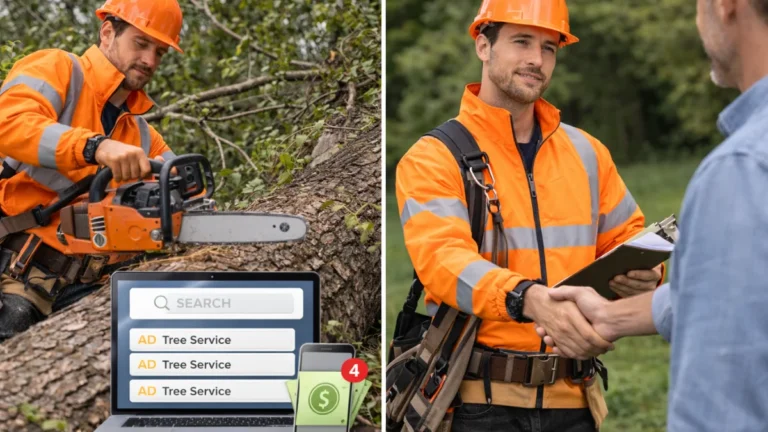

Tree service ads waste budget during storm season due to sudden demand spikes, auction saturation, and reduced control over lead quality. As emergency searches surge, paid advertising platforms amplify competition, causing rapid cost inflation and unstable return on investment.
During storm events, tree service companies, emergency contractors, and insurance-driven vendors compete simultaneously for the same high-urgency keywords. This environment increases cost per click, weakens targeting precision, and introduces unqualified or duplicate leads that consume budget without proportional job conversion. These effects are common in storm-prone regions, including parts of Texas.
This document explains why tree service ads lose efficiency during storm season and how budget waste can be reduced by examining demand volatility, bid inflation mechanics, keyword intent distortion, geographic mismatch, attribution instability, and channel dependency risk. The analysis focuses on structural decisions that influence advertising efficiency rather than tactical platform adjustments.
Why Does Storm Season Increase Tree Service Advertising Costs?
Storm season increases tree service advertising costs because search demand surges within a compressed time window, forcing advertisers into highly competitive auctions. Paid ad platforms respond to this demand by raising bids as more advertisers compete for the same emergency-driven keywords.
During storm events, multiple tree service companies, insurance-affiliated vendors, and emergency contractors target identical high-urgency searches. This concentration of bidders accelerates cost-per-click inflation, even for campaigns that were previously cost-stable.
Advertising platforms prioritize auction dynamics over service urgency. As bid pressure rises, ads are shown based on spending power rather than service readiness, which increases costs without guaranteeing qualified leads.
In storm-prone regions, including many Texas markets, repeated seasonal demand spikes reinforce this pattern. Each storm cycle resets competition at higher price levels, making storm-season advertising structurally more expensive than non-emergency periods.
How Do Demand Spikes Cause Bid Inflation in Tree Service Ads?
Demand spikes cause bid inflation when a large number of advertisers target the same emergency keywords at the same time, compressing competition into a short period. Paid ad auctions respond by increasing bids to allocate limited visibility among more participants.
During storms, emergency tree removal searches surge rapidly, but available ad inventory does not expand at the same rate. This imbalance forces advertisers to outbid one another to maintain impressions, driving up cost per click within hours.
Bid inflation is amplified by automated bidding systems. When platforms detect increased conversion activity, algorithms raise bids to capture perceived value, even as lead quality becomes inconsistent.
This dynamic leads to higher spend without proportional return. Advertisers pay premium prices during peak demand periods, while conversion efficiency declines due to lead saturation, duplicate inquiries, and limited operational capacity to respond quickly.
Why Do Tree Service Ads Attract Low-Quality Leads During Storms?
Tree service ads attract low-quality leads during storms because emergency search behavior broadens and becomes less precise. Homeowners, property managers, and third parties search urgently without clear intent alignment, increasing the volume of unqualified inquiries.
During storm events, search queries often include generic emergency terms without service specificity. Ads triggered by these broad searches capture users who may not require immediate tree removal or who are contacting multiple providers simultaneously.
Lead quality also declines due to duplicate and intermediary-driven inquiries. Insurance representatives, tenants, or third-party coordinators submit inquiries on behalf of property owners, reducing decision authority and slowing job conversion.
High competition and urgency further limit qualification. Tree service companies prioritize response speed over filtering, which increases call volume but reduces close rates and inflates cost per completed job.
How Do Broad and Emergency Keywords Waste Tree Service Ad Budgets?
Broad and emergency keywords waste tree service ad budgets by capturing demand that is urgent but not service-qualified. These keywords trigger ads for a wide range of searches that do not consistently align with actual tree removal needs.
During storm season, advertisers often expand keyword coverage to include generic emergency terms. While these terms increase visibility, they attract users seeking information, insurance guidance, or general assistance rather than immediate tree removal services.
Budget waste increases when broad keywords overlap across competitors. Multiple advertisers pay for the same high-volume emergency searches, driving up costs while splitting limited conversion opportunities.
Emergency keywords perform best when tightly aligned with specific hazards and service actions. Without this alignment, ad spend increases without proportional job bookings, reducing overall advertising efficiency.
Why Does Geographic Targeting Fail During Storm Season Advertising?
Geographic targeting fails during storm season because search demand expands beyond normal service boundaries, while ad platforms continue to distribute impressions based on proximity and bidding pressure rather than operational feasibility.
During widespread storm events, homeowners across multiple cities search simultaneously for emergency help. Ads configured for broad regions begin capturing impressions outside practical response areas, increasing wasted spend on unreachable or low-priority locations.
Location intent also becomes ambiguous. Searches using “near me” during storms often originate from temporary locations, such as workplaces or shelters, reducing geographic accuracy and lead relevance.
Budget waste increases when geographic filters are too wide or dynamically expanded by automated systems. Without tight location control, ads consume spend in areas that do not translate into viable jobs during peak demand periods.
How Do Budget Caps and Pacing Errors Reduce Ad Effectiveness?
Budget caps and pacing errors reduce ad effectiveness during storm season because spend is consumed too quickly during peak demand windows, limiting exposure when response capacity is highest.
Storm-driven demand often surges within hours. Daily budget limits are exhausted early in the day, causing ads to stop running while demand remains active. This results in missed high-intent opportunities later in the surge.
Automated pacing systems may also overcorrect. Platforms attempt to distribute spend evenly but struggle during rapid demand changes, leading to inefficient bid allocation and reduced impression share when competition intensifies.
When budgets are not aligned with operational capacity and response timing, advertising efficiency declines. Spend increases without proportional lead quality or job completion, amplifying budget waste during emergency periods.
Why Is ROI Tracking Unreliable for Tree Service Ads During Storms?
ROI tracking becomes unreliable during storm season because lead attribution breaks down under high-volume, multi-touch demand conditions. Emergency-driven behavior compresses the decision cycle, making it difficult to trace conversions back to a single ad interaction.
During storms, homeowners often contact multiple providers simultaneously, resulting in duplicated calls and overlapping attribution. Paid ads receive credit for inquiries that may not convert into completed jobs, inflating perceived performance.
Tracking accuracy is further reduced by offline conversion gaps. Many emergency jobs are scheduled by phone, resolved quickly, or paid through insurance, limiting data feedback to advertising platforms.
Delayed job completion and variable pricing also distort ROI measurement. Revenue outcomes may occur days or weeks after the initial inquiry, disconnecting spend from measurable return and increasing uncertainty in storm-season ad evaluation.
Why Do Paid Ads Become Riskier Than Organic Channels in Storm Season?
Paid ads become riskier during storm season because costs rise faster than control mechanisms can adapt, while organic channels continue capturing demand without auction-based inflation. This imbalance increases financial exposure for advertisers relying heavily on paid traffic.
During emergency periods, paid advertising platforms prioritize bid competitiveness over relevance or readiness. As a result, advertisers pay premium rates for limited visibility while competing against larger budgets and insurance-backed vendors.
Organic search and map visibility operate differently. Once established, organic channels absorb increased demand without proportional cost increases, providing stability during peak emergency searches.
Risk increases when paid ads function as the primary acquisition channel during storms. Tree service companies with strong organic presence experience lower volatility, while ad-dependent companies face unpredictable costs and diminishing returns.
How Can Tree Service Companies Reduce Ad Budget Waste During Storm Season?
Tree service companies reduce ad budget waste during storm season by shifting focus from reactive bidding to structural demand capture. Reducing dependency on auction-based visibility lowers exposure to bid inflation and lead quality volatility.
Pre-storm positioning plays a critical role. Establishing organic search visibility, local map presence, and emergency service pages before storm events allows companies to absorb demand without escalating ad spend.
Budget efficiency improves when paid ads are used selectively rather than continuously. Limiting exposure to highly specific emergency queries and aligning spend with operational capacity reduces waste.
Diversifying acquisition channels reduces risk. Combining organic visibility, referrals, and controlled paid advertising stabilizes lead flow during storms and prevents overreliance on high-cost emergency ads.
External and market forces that distort tree service advertising during storm season
Storm season exposes tree service advertising to extreme demand compression, auction saturation, and reduced control over lead quality. These external market forces explain why paid ads behave differently during storms than during normal operating periods, regardless of campaign structure or intent.
Are Storm Season Tree Service Ads Always Unprofitable?
No. Storm season ads can produce jobs, but profitability declines when costs inflate faster than conversion efficiency. Selective use reduces risk.
Should Tree Services Pause Ads During Severe Weather?
Not always. Ads may support visibility during peak demand, but reliance should be reduced when costs exceed operational or financial thresholds.
Do Emergency Ads Work Better on Google or Local Services Ads?
Performance varies by market and competition. Both channels experience cost inflation during storms, making organic visibility increasingly valuable.
Can Tree Services Control Ad Costs During Storm Demand?
Cost control is limited during high competition. Structural preparation and channel balance provide more stability than reactive bid adjustments.
What Marketing Channels Perform Best During Storm Season?
Organic search, local map visibility, and referrals perform best because they capture demand without auction-based cost escalation.
How storm-season ad performance for tree services should be interpreted
Tree service ads waste budget during storm season not because advertising stops working, but because auction-based systems amplify instability when demand spikes suddenly. As emergency searches surge, competition intensifies faster than targeting, pricing, or attribution can adapt, driving costs upward while reducing lead clarity.
During storms, ads capture urgency without exclusivity. Homeowners, tenants, insurers, and third parties submit overlapping inquiries, which inflates call volume but weakens decision authority and conversion reliability. Budget is consumed rapidly, often before operational capacity can respond effectively.
Interpreted correctly, storm-season ad inefficiency reflects structural risk rather than execution failure. Paid ads absorb volatility when demand concentrates into short windows, while organic visibility remains insulated from auction pressure. For tree service companies, uneven results during storms signal how the channel behaves under stress—not whether demand exists or service is needed.