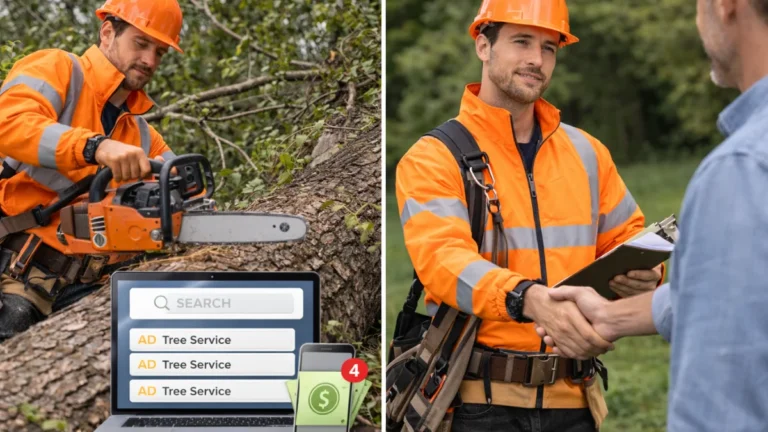


Tree service SEO cost is determined by market competition, service area size, emergency service demand, and the level of local authority required to appear in high-intent search results. Pricing reflects the effort needed to generate consistent, qualified leads rather than short-term visibility.
Tree service businesses operate in a locally competitive and urgency-driven environment. Search demand is influenced by storm events, seasonal risk, and safety concerns, which increases the importance of local SEO, rapid discoverability, and trust signals.
This document analyzes tree service SEO cost by examining pricing ranges, pricing models, cost-determining factors, local SEO budgeting, return on investment, and comparisons with paid acquisition channels. Each section processes a specific cost component to support accurate evaluation and informed marketing investment decisions.
How Much Does SEO Cost for Tree Service Companies?
SEO cost for tree service companies typically ranges from $1,200 to $4,000 per month, depending on local competition, service area coverage, emergency service demand, and growth objectives. Pricing reflects the level of ongoing work required to maintain visibility in local and organic search results.
Lower-cost SEO programs generally cover basic local optimization, including Google Business Profile setup, citation consistency, and limited on-page improvements. These plans are common in low-competition or rural markets with fewer established providers.
Mid-range SEO investments support ongoing content development, technical optimization, review strategy support, and local authority building. This level is required in suburban and mid-size metro markets where multiple tree service companies compete for high-intent searches.
Higher-cost SEO engagements are necessary in dense metro areas or regions with frequent storm-related demand. These programs include expanded location coverage, advanced technical work, and sustained authority development to capture competitive emergency and service-related searches.
What SEO Pricing Models Are Used for Tree Service Businesses?
SEO services for tree service businesses are commonly priced using monthly retainers, project-based fees, or hybrid models. Each pricing structure reflects differences in workload consistency, risk distribution, and long-term visibility requirements.
Monthly retainer pricing is the most common model for tree service SEO. This structure supports continuous local optimization, content updates, authority building, and seasonal demand adjustments, which are necessary in competitive and emergency-driven markets.
Project-based pricing is typically used for limited scopes such as website launches, technical audits, or initial local SEO setup. While this model reduces short-term cost, it does not support sustained rankings or consistent lead flow.
Hybrid models combine a base retainer with defined projects or performance benchmarks. This approach allows flexibility while maintaining ongoing optimization needed to respond to competition and seasonal search volatility.
Pricing model selection affects cost predictability, scalability, and long-term effectiveness. Tree service companies benefit most from models that support continuous execution rather than one-time optimization efforts.
What Factors Determine Tree Service SEO Costs?
Tree service SEO costs are determined by local competition, service area size, emergency service demand, website condition, and lead volume goals. These factors define the scope, intensity, and duration of optimization required.
Competition level is a primary cost driver. Markets with many established tree service providers require stronger content coverage, higher review volume, and sustained authority signals to achieve and maintain visibility.
Service area size directly affects cost. Companies serving multiple cities or counties need location-specific pages, expanded internal linking, and stronger geographic relevance signals.
Emergency and storm-related demand increases cost complexity. SEO strategies must account for sudden spikes in search volume and heightened competition during severe weather events.
The technical condition of the website influences upfront investment. Sites with slow performance, mobile usability issues, or weak structure require remediation before rankings can improve.
Lead volume and growth targets also shape pricing. Higher lead goals require broader keyword coverage, deeper content systems, and ongoing authority development rather than minimal local optimization.
How Much Should Tree Service Companies Budget for Local SEO?
Tree service companies typically allocate $1,500 to $3,200 per month for local SEO, depending on market competition, service radius, and the importance of emergency and storm-response visibility.
Local SEO budgets focus on map visibility, geographic relevance, and trust signals rather than broad keyword expansion. Single-location companies in low-competition areas can operate at the lower end of the range, while multi-city operators require sustained investment.
A standard local SEO budget supports Google Business Profile optimization, citation management, localized service pages, review acquisition support, and ongoing on-page improvements. These elements strengthen proximity, relevance, and credibility.
Higher budgets are required in urban or storm-prone markets where competition intensifies during peak demand periods. In these environments, local SEO investment must also support content depth, internal linking, and off-site authority signals.
Local SEO budgeting should align with average job value and lead consistency goals. Because tree service jobs often involve urgent safety concerns, strong local visibility delivers high-return leads when demand spikes.
What Is Typically Included in Tree Service SEO Pricing?
Tree service SEO pricing typically includes technical optimization, local SEO execution, content development, authority building, and performance tracking. The exact scope scales based on competition, service coverage, and emergency demand intensity.
Technical SEO addresses crawlability, site speed, mobile usability, indexation, and internal structure. These elements ensure search engines can efficiently process tree service pages during high-demand periods.
Local SEO deliverables include Google Business Profile optimization, citation consistency, service-area relevance signals, and review strategy support. These components are critical for map visibility and proximity-based searches.
Content development focuses on service pages, location pages, and supporting content for emergency tree removal, trimming, and storm response. Content depth increases as competition and service area coverage expand.
Authority building includes link acquisition, brand mentions, and local references that validate legitimacy and expertise. Because tree services involve safety and liability risk, strong off-site trust signals are required.
Reporting and performance tracking measure leads, calls, and conversions. Effective SEO pricing emphasizes business outcomes rather than isolated keyword movement.
What Return on Investment Can Tree Service Companies Expect From SEO?
Tree service companies typically achieve a positive return on investment within 4 to 9 months, depending on competition level, emergency demand frequency, and local visibility strength. ROI accelerates as organic rankings and map presence stabilize.
SEO performs well in the tree service industry because of high lead urgency and strong close rates. A small number of emergency or large removal jobs can offset several months of SEO investment once consistent visibility is achieved.
Organic leads convert efficiently because homeowners searching for tree services often face immediate safety or property risks. This urgency reduces comparison time and increases call-to-job conversion rates compared to non-urgent service categories.
ROI improves over time as content coverage expands, review volume grows, and local authority compounds. Unlike paid ads, SEO continues generating leads without proportional increases in monthly spend.
Accurate ROI evaluation depends on tracking calls, booked jobs, revenue per lead, and seasonal demand spikes, not rankings alone. Tree service SEO performs best when measured as a long-term demand system with compounding returns.
How Do Tree Service SEO Costs Compare With Google Ads and Other Channels?
Tree service SEO costs differ from Google Ads and other marketing channels because SEO compounds over time, while paid channels require continuous spending to maintain visibility and lead flow. Each channel uses a different cost and risk structure.
Google Ads deliver immediate exposure, especially for emergency and storm-related searches. However, cost per click increases sharply during high-demand periods, and lead flow stops as soon as budgets are paused, creating volatility and dependency.
SEO requires upfront and ongoing investment, but cost per lead decreases as rankings, map visibility, and authority stabilize. Once established, organic leads continue without proportional increases in monthly spend, improving long-term efficiency.
Other channels such as directories, marketplaces, and referrals supplement demand but lack control and scalability. SEO functions as an owned acquisition channel, while ads and marketplaces function as rented visibility.
Cost efficiency improves when SEO serves as the primary demand foundation, with paid channels used selectively for emergency coverage, seasonal spikes, or market entry rather than ongoing dependence.
Should Tree Service Companies Hire an Agency, Freelancer, or Do SEO In-House?
Tree service companies generally achieve more consistent results by working with an SEO agency or specialized provider, because effective SEO in this industry requires coordinated technical work, local optimization, content systems, and authority building.
SEO agencies provide structured processes, access to specialized tools, and experience managing competitive and emergency-driven local markets. This model supports scalability, seasonal demand shifts, and sustained visibility across service areas.
Freelancers are suitable for limited tasks such as on-page optimization, citation cleanup, or content updates. However, most freelancers lack the capacity to manage technical SEO, authority acquisition, and long-term execution simultaneously.
In-house or DIY SEO is constrained by time, expertise, and tooling. While basic tasks like review responses or listing updates can be managed internally, sustained growth in competitive tree service markets typically requires external specialization.
The choice depends on budget, competition level, and growth objectives, but as market pressure increases, structured systems and dedicated expertise become critical to SEO performance.
Market and demand factors that shape tree service SEO costs
Tree service SEO costs are shaped by how demand forms under safety risk, local competition, and emergency-driven search behavior. External forces such as storm frequency, service area coverage, and market density explain why pricing varies widely and why higher investment is required in competitive or high-risk environments. These factors influence workload intensity, authority requirements, and the level of sustained effort needed to generate consistent leads.
How Long Does Tree Service SEO Take to Produce Leads?
Tree service SEO typically begins generating leads within 3 to 5 months, with stronger consistency developing between 6 and 9 months as local authority and map visibility stabilize.
Can Small Tree Service Businesses Afford SEO?
Small tree service businesses can afford SEO by focusing on local-first optimization, targeting core services and service areas rather than broad regional coverage.
Does Emergency Tree Work Affect SEO Budgeting?
Yes. Emergency tree work increases competition and bidding pressure during storms, which raises the importance of strong organic and map visibility and may require higher SEO investment.
Is Cheap SEO Risky for Tree Service Companies?
Cheap SEO is risky because it often relies on thin content, automated tactics, or outdated link practices that fail to build trust and may harm long-term visibility.
How Do Tree Companies Evaluate SEO Pricing Fairness?
SEO pricing is evaluated by lead consistency, job value, and revenue impact, not keyword counts or traffic volume. Fair pricing aligns cost with measurable business outcomes.
How tree service SEO costs should be interpreted over time
Tree service SEO costs reflect the level of effort required to maintain trust, visibility, and responsiveness in a high-risk local market, not arbitrary pricing. Markets with dense competition, wide service areas, and frequent emergency demand require more ongoing work to remain visible when homeowners act under pressure.
Higher SEO investment does not purchase traffic alone. It supports the systems needed to compete during storm events, maintain map visibility, and convert urgent searches into qualified jobs. Lower-cost programs succeed only where competition and demand volatility remain limited.
Interpreted correctly, tree service SEO pricing mirrors business reality. Cost scales with competition, urgency, and lead value. When evaluated against consistent lead flow, job size, and long-term visibility, SEO functions as a compounding demand channel rather than a short-term expense.