
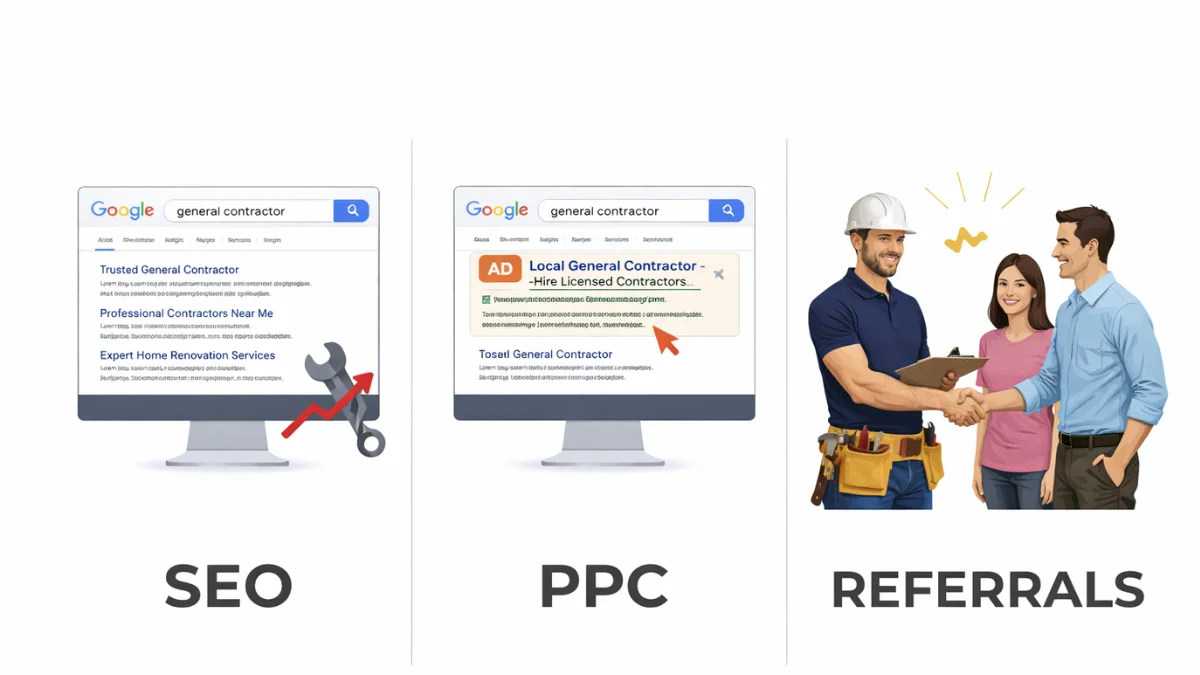

General contractors rely on SEO, paid advertising, and referrals as primary lead sources, but each channel operates under different cost structures, timelines, and risk profiles. The choice between them affects not only lead volume, but also project quality and long-term stability.
SEO builds visibility gradually through search demand, PPC generates immediate exposure through paid placement, and referrals depend on trust and past performance. These channels attract leads at different stages of readiness and with varying levels of qualification.
This article compares SEO, PPC, and referrals for general contractors by examining how each channel produces leads, how costs and timelines differ, and how scalability and risk influence long-term growth decisions.
How does SEO generate leads for general contractors compared to PPC and referrals?
SEO generates leads by capturing demand at the moment general contractors are actively being researched and compared. Leads come from search behavior tied to project planning, evaluation, and readiness rather than immediate outreach or past relationships.
PPC generates visibility through paid placement. Leads appear quickly but depend on continuous spend and bidding conditions. Clicks often reflect urgency or convenience rather than deep qualification, especially in competitive markets.
Referrals rely on trust built through prior work. Leads are typically well-qualified but inconsistent, limited by past project volume and network reach rather than scalable demand.
Each channel reflects a different acquisition mechanism. SEO builds compounding visibility, PPC buys immediate access, and referrals depend on historical relationships. Their lead flow characteristics differ accordingly.
How do lead quality and project value differ between SEO, PPC, and referrals?
Lead quality and project value differ by channel because each attracts buyers at different stages of readiness and trust. SEO, PPC, and referrals surface demand through distinct behaviors, which affects qualification depth and deal size.
SEO leads tend to be research-driven and comparison-oriented. Buyers arrive after evaluating options, which often results in higher alignment with scope and expectations. Project value is typically moderate to high due to informed selection.
PPC leads are more variable. Some reflect urgent or time-sensitive needs, while others are exploratory clicks. Qualification depends heavily on targeting and messaging, and project value can fluctuate widely.
Referral leads are usually the most qualified. Trust is pre-established, reducing friction and increasing close rates. However, volume is limited, and project value depends on the referring network’s typical work scale.
How do cost structures compare between SEO, PPC, and referral-based growth?
Cost structures differ because each channel requires a different type of investment and carries different levels of cost predictability. SEO, PPC, and referrals distribute expense across time, volume, and dependency in distinct ways.
SEO costs are typically fixed and ongoing. Investment supports content development, site authority, and visibility maintenance. Costs are front-loaded, but marginal cost per lead often decreases as visibility compounds.
PPC costs are variable and demand-driven. Spend increases with competition, bid pressure, and click volume. Leads stop immediately when spend stops, creating direct dependency on continuous budget allocation.
Referral-based growth has low direct acquisition cost but high indirect dependency. Revenue relies on past performance, relationships, and timing, making growth unpredictable and difficult to scale intentionally.
How long does it take to see results from SEO, PPC, and referrals for general contractors?
Time to results differs because each channel activates demand through different mechanisms. SEO, PPC, and referrals produce leads on very different timelines, which affects planning and expectation setting.
SEO results develop gradually. Visibility builds as content, authority, and trust signals accumulate across buying stages. Early traction is incremental, but stability improves over time as rankings mature.
PPC results are immediate. Leads can appear as soon as campaigns launch, but performance depends on active spend, bidding conditions, and competition. There is no compounding effect once spending stops.
Referral results are irregular. Leads arrive when past clients or partners recommend a contractor, making timing unpredictable. While close rates are often strong, volume and consistency are outside direct control.
How scalable is each channel for growing general contracting businesses?
Scalability differs because each channel expands under different constraints. SEO, PPC, and referrals respond differently to increased demand, geographic expansion, and business growth.
SEO scalability improves over time. As visibility and authority grow, the same content and rankings can attract demand across multiple services or regions without proportional cost increases. Growth is gradual but cumulative.
PPC scalability is linear and cost-dependent. Increasing lead volume requires higher spend, broader targeting, or more aggressive bidding. As competition rises, costs often increase faster than lead quality.
Referral scalability is limited by network size and past project volume. While trust is strong, growth depends on external behavior rather than controllable inputs, making referrals difficult to scale intentionally.
What risks and limitations exist with SEO, PPC, and referral dependence?
Each acquisition channel carries distinct risks tied to control, predictability, and dependency. SEO, PPC, and referrals expose general contractors to different forms of volatility that affect long-term stability.
SEO risks center on time and consistency. Results take longer to materialize, and visibility depends on sustained effort. However, once established, risk decreases as authority and demand become more durable.
PPC risks are financial and competitive. Rising bid costs, click inflation, and platform changes can quickly erode margins. Lead flow is entirely dependent on continuous spending, creating immediate exposure to budget constraints.
Referral dependence carries concentration risk. Lead volume is limited by past relationships and timing, and sudden slowdowns can occur without warning. Overreliance reduces control over growth and forecasting.
How do buyer intent and decision stage vary by SEO, PPC, and referrals?
Buyer intent and decision stage vary by channel because each captures demand at a different point in the hiring process. SEO, PPC, and referrals surface leads with distinct levels of readiness and trust.
SEO buyers typically arrive during research or comparison stages. They are evaluating options, validating capability, and aligning scope, which often leads to informed, higher-quality engagements over time.
PPC buyers are often urgency-driven or convenience-focused. Some are ready to act immediately, while others are still exploring. Intent quality depends heavily on targeting precision and message alignment.
Referral buyers usually enter at a late decision stage. Trust is pre-established, reducing evaluation time and increasing close rates. However, volume is limited by network activity rather than active demand capture.
How do general contractors combine SEO, PPC, and referrals across growth stages?
General contractors rarely rely on a single acquisition channel over time. SEO, PPC, and referrals tend to function as complementary systems that support different growth stages rather than interchangeable options.
Early-stage contractors often depend on PPC for immediate visibility while referrals develop organically. SEO plays a foundational role during this phase, even though lead volume remains limited initially.
As visibility and reputation grow, SEO becomes the primary demand-capture channel, supported by referrals that reinforce trust and close efficiency. PPC shifts into a supplemental role, often used to fill short-term gaps or target specific project types.
At maturity, SEO and referrals provide stability, while PPC is used selectively. This combination reduces volatility, improves forecasting, and distributes risk across controllable and relationship-based channels.
How does channel effectiveness vary by general contractor type?
Channel performance changes significantly based on the type of general contracting work being performed. Residential, commercial, and specialty contractors attract different buyer behaviors and intent patterns.
Residential general contractors benefit more evenly from SEO and PPC. Homeowners often search directly for services, making organic visibility and paid placement effective, while referrals accelerate trust for higher-value remodels.
Commercial general contractors rely more heavily on SEO and referrals. Commercial buyers research extensively, evaluate credentials, and move through longer procurement cycles. PPC plays a limited role due to lower search volume and higher qualification requirements.
Specialty or niche contractors often see disproportionate value from SEO. Targeted visibility around specific services or project types reduces competition and improves lead quality, while referrals reinforce authority within a narrower market.
How do SEO, PPC, and referrals affect project margins over time?
Acquisition channels influence margin differently as competition and scale increase. Understanding this impact is critical for sustainable growth.
SEO improves margin over time. As visibility compounds, the cost per lead typically decreases while lead quality stabilizes, allowing pricing discipline and stronger negotiation positions.
PPC pressures margin as markets mature. Bid inflation, click competition, and variable conversion rates increase acquisition costs, which can compress profit unless pricing flexibility exists.
Referrals protect margin but limit scale. Close rates are high and acquisition cost is low, but reliance on referrals constrains growth and exposes revenue to timing fluctuations beyond operational control.
How does risk exposure change over time for each lead channel?
Risk is not static; it emerges at different points depending on the channel.
PPC risk is immediate. Lead flow stops when spending stops, and cost volatility can appear suddenly due to competition or platform changes.
Referral risk is delayed. Early performance may be strong, but over time dependency risk increases as growth becomes tied to past clients rather than active demand.
SEO risk is front-loaded but declines. Early investment carries uncertainty, but once authority and visibility stabilize, dependency risk decreases and resilience improves.
Understanding when risk appears helps contractors balance short-term needs with long-term stability.
What factors should general contractors consider when choosing a primary lead source?
Choosing a primary lead source depends on business maturity, project mix, competitive pressure, and risk tolerance. SEO, PPC, and referrals perform differently depending on how predictable demand needs to be and how much control a contractor requires over growth.
How does business maturity affect channel effectiveness?
Business maturity influences which channels perform reliably. Established contractors benefit more from SEO and referrals due to existing credibility, while newer businesses often rely on PPC for immediate exposure until long-term visibility develops.
Why does project type influence channel performance?
Project type affects buyer behavior. High-value or complex projects align better with SEO and referrals, where buyers research deeply, while smaller or urgent projects are more likely to originate through PPC-driven searches.
How does market competition change channel ROI?
In competitive markets, PPC costs rise quickly, reducing efficiency. SEO becomes more valuable over time as organic visibility offsets paid spend, while referrals remain stable but limited by network size rather than market share.
Why does overreliance on one channel increase risk?
Dependence on a single channel exposes contractors to volatility. PPC depends on budget continuity, referrals fluctuate with past workload, and SEO requires time. Diversification reduces exposure and stabilizes lead flow across market shifts.
How general contractors typically prioritize SEO, PPC, and referrals
In practice, most sustainable general contracting businesses treat SEO as the primary long-term acquisition channel, supported by referrals for trust reinforcement and selective PPC for immediacy or gap coverage.
Overreliance on any single channel increases exposure to volatility. Balanced systems distribute risk, stabilize lead flow, and align acquisition with how buyers actually research and hire contractors.
The most resilient growth models recognize that speed, trust, and durability are delivered by different channels at different times—and structure lead generation accordingly.