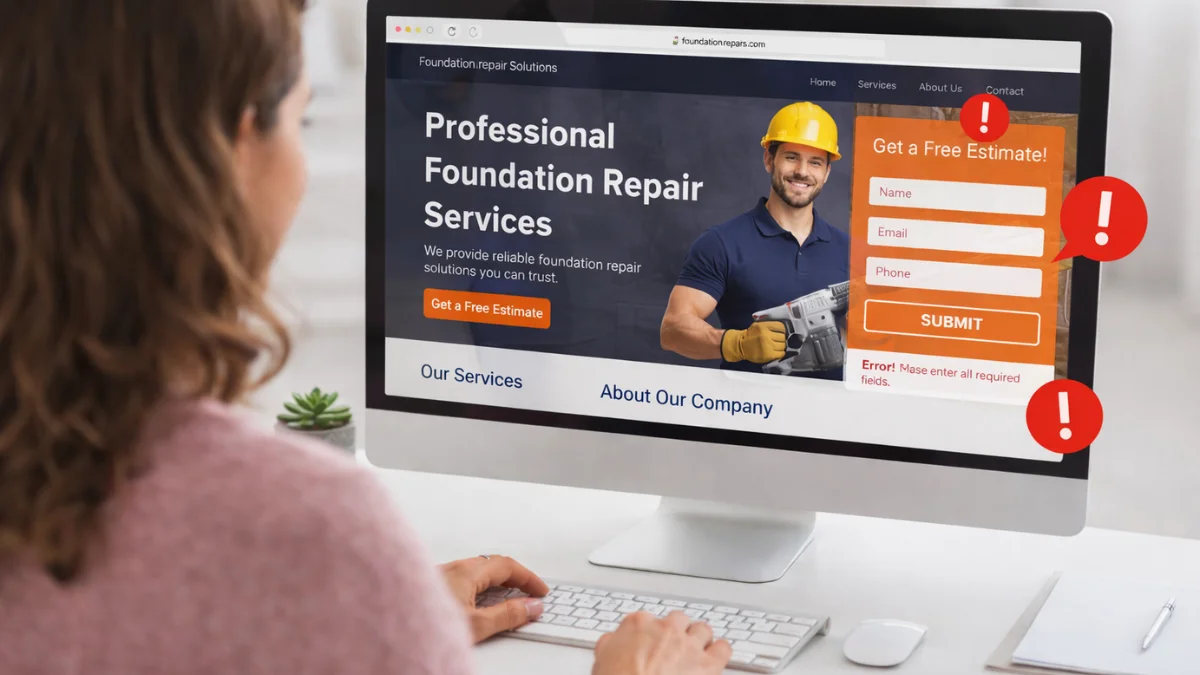

Foundation repair websites often receive traffic but struggle to generate inquiries because the homeowner decision process is complex, emotional, and high-risk. Visitors arrive seeking validation and reassurance, not sales pressure or surface-level service descriptions.
Foundation issues trigger fear, skepticism, and hesitation. Homeowners worry about cost, severity, and whether repairs are truly necessary. When websites fail to address these concerns clearly, visitors leave to continue researching rather than contacting a contractor.
This article explains why foundation repair websites fail to convert, focusing on trust gaps, missing education, unclear inspection processes, pricing ambiguity, and misaligned calls to action that prevent homeowners from taking the next step.
Why do foundation repair websites attract traffic but fail to generate calls?
Foundation repair websites attract traffic because homeowners actively research symptoms, causes, and risks. However, conversion fails when the page does not resolve the visitor’s primary need: validation of seriousness and next steps, not a sales pitch.
Most visitors arrive in a confirmation phase. They are checking whether cracks, settling, or uneven floors indicate a real structural issue. When pages jump straight to services without confirming risk, visitors hesitate and continue researching elsewhere.
Another failure point is intent mismatch. Traffic often lands on broad educational pages, but the site does not bridge that information into a clear, low-pressure path toward an inspection or evaluation. The gap between learning and action remains unresolved.
Finally, weak trust signaling suppresses action. High-ticket decisions amplify skepticism. Without clear proof, process transparency, and reassurance, traffic stays informational instead of converting into calls.
How does homeowner fear and skepticism affect foundation repair conversions?
Homeowner fear and skepticism slow foundation repair conversions because the perceived downside of making a wrong decision is high. Visitors worry about unnecessary work, inflated costs, or being pressured into repairs they do not fully understand.
Fear creates decision paralysis. Instead of acting quickly, homeowners seek multiple confirmations, opinions, and explanations. Websites that do not directly acknowledge this fear fail to build emotional and rational safety.
Skepticism is reinforced by industry reputation. Foundation repair is often associated with aggressive sales tactics, which makes homeowners cautious. If the website language feels promotional rather than explanatory, trust erodes further.
Effective conversion requires reassurance before persuasion. When websites fail to normalize doubt, explain uncertainty, and slow the decision down appropriately, homeowners leave—even when the underlying need is real.
Why does lack of education prevent homeowners from taking action?
Lack of education prevents action because homeowners cannot confidently assess whether a foundation issue is minor or serious. When uncertainty remains high, the safest choice feels like delaying contact rather than initiating it.
Many foundation repair websites explain what services they offer but fail to explain how foundation problems develop, worsen, or stabilize. Without this context, visitors cannot judge urgency or necessity, so they postpone decisions.
Educational gaps also affect trust. When homeowners do not understand causes, warning signs, or consequences, they suspect recommendations may be exaggerated. This skepticism pushes them to seek more information elsewhere instead of requesting an inspection.
Action occurs when education reduces ambiguity. When websites fail to clearly explain risk progression and decision thresholds, homeowners remain stuck in research mode rather than moving forward.
How do unclear inspection and evaluation processes reduce conversions?
Unclear inspection and evaluation processes reduce conversions because homeowners do not know what will happen after they make contact. Fear of pressure, unexpected costs, or invasive assessments creates hesitation.
Many websites mention inspections without explaining scope, duration, or outcomes. Homeowners are left guessing whether an inspection is free, binding, or designed to lead directly to a sales pitch.
This uncertainty is amplified by the high-ticket nature of foundation repair. Without a clear explanation of how problems are assessed and how recommendations are formed, visitors delay contact to protect themselves from perceived risk.
Conversion improves when the inspection process feels predictable and low-risk. When websites fail to define expectations clearly, homeowners choose inaction over engagement.
Why does pricing ambiguity stall foundation repair inquiries?
Pricing ambiguity stalls inquiries because homeowners cannot anchor the decision to a realistic range or process. When costs feel unknowable, the perceived risk of making contact increases rather than decreases.
Foundation repair websites often avoid pricing entirely or present extremes without context. This leaves visitors unsure whether their issue represents a minor adjustment or a major structural project, which delays action.
Ambiguity also fuels fear of sales pressure. Homeowners worry that requesting an inspection will commit them to unaffordable recommendations. Without clarity on how pricing is determined, they protect themselves by continuing research elsewhere.
Action becomes more likely when pricing is framed as process-based, not quote-based. When websites fail to explain how scope, severity, and methods influence cost, uncertainty overrides intent.
How do weak proof and credibility signals undermine trust?
Weak proof undermines trust because foundation repair decisions depend on confidence in expertise, not marketing claims. Homeowners need evidence that a contractor understands structural problems and has resolved similar cases successfully.
Many websites rely on generic assurances rather than specific demonstrations of experience. Without clear outcomes, explanations, or real-world context, visitors struggle to differentiate one company from another.
Credibility gaps also magnify skepticism. High-ticket services amplify concern about unnecessary work, making homeowners cautious when proof feels thin or superficial.
Trust grows when proof reduces doubt. When websites fail to show clear experience, process understanding, or problem resolution depth, visitors delay contact to seek validation elsewhere.
Why do generic service pages fail for foundation repair companies?
Generic service pages fail because they treat foundation repair like a simple, repeatable service instead of a diagnostic structural problem. Homeowners do not see their specific concern reflected, which reduces confidence that the company understands their situation.
Many pages reuse broad descriptions that could apply to any property or region. When cracks, settling, or movement are described without context, visitors cannot connect symptoms to causes or severity, so urgency remains unclear.
Generic language also weakens differentiation. If every company claims experience without explaining how problems are evaluated or resolved, homeowners see little reason to choose one provider over another.
Conversion improves when pages reflect problem specificity. When websites fail to address unique conditions, symptoms, and decision thresholds, visitors continue searching for clearer answers elsewhere.
How does poor geographic or soil-specific relevance hurt foundation repair conversion?
Poor geographic or soil-specific relevance hurts conversion because foundation problems are heavily influenced by local conditions. When websites ignore regional soil behavior or climate factors, explanations feel incomplete or generic.
Homeowners want confirmation that their issue is common in their area and understood by the contractor. Without references to local soil types, moisture patterns, or structural trends, trust erodes.
This gap is especially damaging in high-risk regions where expansive soils or drought cycles are known contributors to foundation movement. If the website does not acknowledge these factors, visitors doubt its relevance.
Conversion improves when local context reduces uncertainty. When geographic and soil-specific factors are missing, homeowners leave to seek regionally grounded validation instead of contacting the company.
Why do calls-to-action fail on foundation repair websites?
Calls-to-action fail on foundation repair websites because they are often framed around urgency or sales readiness instead of reassurance and control. Homeowners are not yet ready to “get started” or “schedule now” when fear and uncertainty remain unresolved.
Many CTAs assume commitment. Phrases that imply obligation, cost, or pressure increase resistance rather than action, especially for high-ticket structural decisions. Visitors hesitate when they feel a click will lock them into a sales conversation.
Another failure point is misaligned timing. CTAs appear before the website has validated seriousness, explained the inspection process, or established trust. When the emotional and informational groundwork is missing, the CTA feels premature.
Effective CTAs in foundation repair acknowledge hesitation. They invite evaluation, confirmation, or conversation, not purchase. When calls-to-action fail to match the homeowner’s decision stage, traffic exits instead of converting.
What external factors influence foundation repair website conversions?
Foundation repair website conversions are influenced by factors outside the website’s direct control, including long decision cycles, second-opinion behavior, economic conditions, and offline validation sources. These external forces shape when homeowners are willing to make contact, even when intent already exists.
How do long decision cycles affect contact timing?
Foundation repair decisions unfold slowly because homeowners must validate risk, affordability, and necessity. Even when intent exists, visitors often leave to reflect or gather more information before making contact.
Why do second opinions delay inquiries?
High-ticket structural work triggers comparison behavior. Homeowners frequently consult multiple sources—engineers, inspectors, neighbors, or forums—before trusting a contractor, which extends the path from visit to inquiry.
How do economic conditions affect risk tolerance?
Economic uncertainty increases hesitation. When budgets feel constrained, homeowners delay action unless risk feels unavoidable, making reassurance and clarity more important than urgency.
When do homeowners leave to seek validation elsewhere?
Visitors exit when a website fails to confirm seriousness or explain next steps clearly. They seek validation from other sources rather than contacting a company that feels unclear or untrustworthy.
Why Foundation Repair Websites Struggle to Turn Visits into Calls
Foundation repair websites fail to convert because they do not align with how homeowners actually make high-risk, high-cost decisions. Visitors arrive seeking validation, clarity, and reassurance, not sales pressure or generic service descriptions.
Fear, skepticism, and uncertainty slow action. When websites fail to educate, explain inspection processes, establish credibility, or contextualize pricing, homeowners choose delay over engagement.
Conversion improves when websites reduce decision friction rather than amplify it. Foundation repair companies that acknowledge hesitation, explain uncertainty, and guide homeowners through evaluation stages are far more likely to turn traffic into qualified calls.