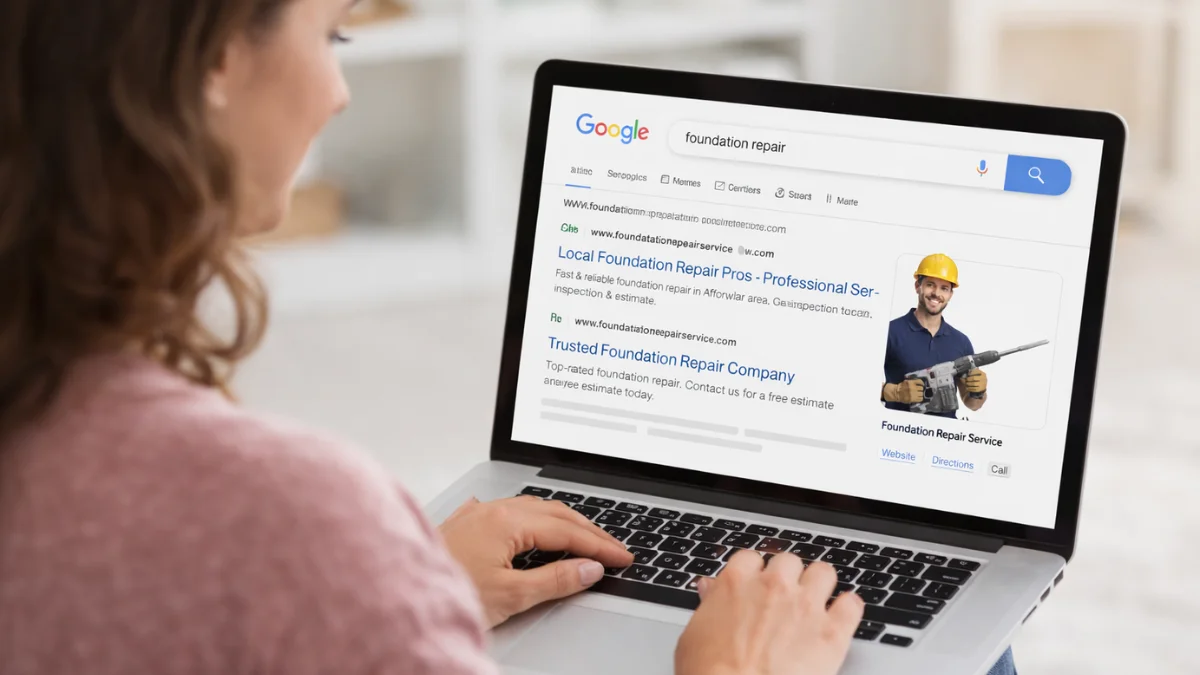

Homeowners search for foundation repair services through a slow, research-heavy process shaped by uncertainty, fear of over-repair, and the need for validation. Most searches begin long before a contractor is contacted, often triggered by visible symptoms rather than a confirmed diagnosis.
Early searches focus on understanding whether cracks, uneven floors, or sticking doors indicate a serious structural problem. As concern increases, homeowners move through multiple search stages—validating risk, researching causes, comparing repair methods, and assessing whether professional intervention is necessary.
This article explains how homeowners search for foundation repair services from first symptom recognition to late-stage hiring intent. It breaks down the sequence of searches, the questions asked at each stage, and the signals that indicate when a homeowner is finally ready to contact a foundation repair company.
How do homeowners first recognize a potential foundation problem?
Homeowners typically recognize a potential foundation problem through visible structural symptoms, not through technical diagnosis. Early awareness is triggered by changes that feel abnormal but ambiguous, such as wall cracks, uneven floors, or doors that no longer close properly.
Initial recognition is observational rather than intentional. Symptoms appear gradually, often after seasonal shifts, heavy rain, or drought. At this stage, homeowners do not search for “foundation repair” directly; they search to understand whether what they are seeing is normal settling or a warning sign.
Search behavior in this phase reflects pre-intent uncertainty. Queries focus on individual symptoms, comparisons, and reassurance rather than solutions. Homeowners are trying to determine whether the issue belongs to cosmetic maintenance or structural concern.
Recognition deepens when symptoms persist or multiply. The presence of multiple indicators—cracks combined with sloping floors or exterior separation—pushes homeowners from passive noticing into active investigation, setting the stage for risk validation searches.
How do homeowners search to determine whether foundation damage is serious?
Once a potential issue is recognized, homeowners search to validate severity and consequence, not to hire a contractor. The core question becomes whether the problem is progressing, dangerous, or likely to affect property value.
Searches in this stage focus on interpretation and thresholds. Homeowners look for explanations that differentiate minor settling from structural failure, often comparing images, scenarios, and timelines to their own situation.
This phase represents mid-intent behavior. The homeowner is no longer asking “what is this?” but “what happens if I do nothing?” Queries explore risk escalation, long-term damage, and whether symptoms worsen over time or stabilize.
Trust is built through consistency across sources. Homeowners compare explanations from multiple websites, forums, inspectors, and educational resources to confirm seriousness. Only when severity feels credible do searches begin shifting toward causes, repair methods, and professional evaluation.
At this point, search behavior signals readiness to move forward—but not yet readiness to hire. The homeowner is still validating risk before accepting the need for expert intervention.
How do homeowners research causes of foundation problems?
After validating that an issue may be serious, homeowners shift their searches toward causation and responsibility. The goal is to understand why the problem exists before accepting any proposed solution.
Search behavior in this stage centers on environmental, structural, and construction-related causes. Homeowners investigate how soil movement, moisture variation, drainage failures, and building practices contribute to foundation movement. This is where regional and property-specific factors become important.
These searches represent mid-intent analytical behavior. Homeowners are not yet solution-focused; they are building a mental model of cause-and-effect. Queries often attempt to connect symptoms to underlying mechanisms rather than outcomes.
Causation research also serves a defensive purpose. By understanding causes, homeowners try to assess whether the issue is preventable, temporary, or likely to recur. This stage heavily influences trust later, because repair recommendations that do not align with the homeowner’s understanding are often rejected.
Only once homeowners feel confident about why the problem exists do they begin accepting that remediation may be required.
How do homeowners search for foundation repair options and methods?
When cause is reasonably understood, homeowners move into solution exploration, focusing on repair approaches rather than contractors. The search question becomes how foundation problems are fixed, not who fixes them.
Search behavior in this stage revolves around method comparison. Homeowners research stabilization systems, structural reinforcement techniques, drainage correction, and long-term mitigation strategies. They compare permanence, disruption, and effectiveness rather than price alone.
This stage reflects upper-mid to late-intent behavior. The homeowner has accepted that repair may be necessary but has not yet committed to professional involvement. Searches aim to understand options well enough to evaluate recommendations later.
Method research also functions as control-building. By understanding repair options in advance, homeowners reduce fear of being oversold or rushed. This knowledge becomes a benchmark against which contractors are judged.
Once homeowners feel they understand available repair paths and their implications, search behavior begins transitioning toward evaluating whether professional intervention is needed and which type of provider is appropriate.
How do homeowners evaluate whether they need a foundation repair company?
Homeowners evaluate whether they need a foundation repair company by weighing risk certainty against intervention cost. At this stage, the decision is no longer about symptoms or causes, but about whether professional involvement is justified.
Search behavior becomes decision-oriented. Homeowners look for indicators that separate monitoring from action, such as progression signs, safety implications, or resale impact. They want confirmation that the issue exceeds DIY, cosmetic, or wait-and-see thresholds.
This phase reflects late mid-intent behavior. Queries often reference inspections, professional opinions, or expert evaluation rather than repair itself. The homeowner is testing whether outside authority is required to move forward.
Evaluation is also shaped by fear of over-repair. Homeowners seek reassurance that contacting a company does not automatically lead to unnecessary work. Clear distinctions between assessment, recommendation, and execution become important validation points.
Only when perceived risk outweighs perceived downside do homeowners accept the need for a foundation repair company, which sets the stage for direct comparison.
How do homeowners compare foundation repair companies online?
When homeowners begin comparing foundation repair companies, search behavior shifts toward trust differentiation rather than technical understanding. The core question becomes who is credible enough to diagnose and resolve the issue correctly.
Searches in this stage focus on proof and reassurance. Homeowners compare explanations, experience signals, and clarity of process rather than marketing claims. They look for consistency between what companies say and what they have demonstrably done.
This represents late-intent behavior. The homeowner is no longer exploring options broadly; they are narrowing choices to a short list. Small trust gaps—unclear processes, vague outcomes, or overly aggressive language—can eliminate candidates quickly.
Comparison is rarely about price alone. Homeowners weigh confidence, transparency, and perceived honesty more heavily than cost estimates, especially for high-ticket structural decisions.
Once comparison yields a provider that feels safe and credible, search behavior transitions into contact readiness rather than continued research.
How does fear of cost and over-repair shape foundation repair search behavior?
Fear of cost and over-repair significantly slows foundation repair searches because homeowners perceive a high risk of being pressured into unnecessary work. This fear influences not only when they search, but how deeply they continue researching before making contact.
Search behavior in this stage becomes defensive and comparative. Homeowners look for cost ranges, warning signs of exaggeration, and explanations that help distinguish minor issues from structural failure. Queries often seek reassurance rather than solutions.
This phase reflects late mid-intent hesitation. The homeowner accepts that a problem may exist but searches to protect themselves from financial overcommitment. Content that feels sales-driven increases exit behavior rather than trust.
Cost fear also extends the research loop. Homeowners revisit earlier stages—symptoms, causes, and methods—to confirm that repair is unavoidable. This looping behavior delays contractor contact even when intent is present.
Only when search results consistently reinforce necessity and proportionality does fear subside enough for the homeowner to move forward.
How do homeowners’ searches change right before contacting a foundation repair contractor?
Right before contacting a foundation repair contractor, homeowner searches shift from exploration to confirmation and access. The language becomes shorter, more specific, and oriented toward next steps rather than understanding.
Late-stage searches often focus on process clarity. Homeowners look for what happens during an inspection, how recommendations are made, and whether evaluation can occur without commitment. These queries signal readiness paired with residual caution.
This stage represents post-intent execution behavior. The homeowner has accepted the likelihood of repair and is now validating that contact will feel safe, controlled, and informative rather than confrontational.
Search patterns also become repetitive. Homeowners revisit the same few sites, comparing consistency of explanations and tone, which indicates narrowing choice rather than continued discovery.
Once reassurance aligns with readiness, searching stops. The homeowner transitions from validation to action, and contact becomes the logical next step rather than a risk.
What external factors influence how homeowners search for foundation repair services?
Homeowner search behavior for foundation repair is shaped by factors beyond the website or the contractor, including property value concerns, regional soil conditions, peer validation, and timing pressures. These external influences determine how deeply homeowners research, how long they hesitate, and when they are willing to make contact.
How does home value and resale timing affect search urgency?
Homeowners searching near a sale or refinance tend to research more intensely and move faster toward professional evaluation. When resale value or inspection outcomes are at stake, searches compress from exploration into validation and action.
Why do regional soil conditions shape search depth?
In areas with known expansive soils or moisture variation, homeowners research more extensively to understand recurrence risk. Local soil behavior increases search depth as homeowners try to predict whether issues will stabilize or worsen.
How does peer advice and offline validation influence searches?
Advice from neighbors, inspectors, or online communities often pauses or redirects search behavior. Homeowners use these inputs to validate or challenge what they find online before proceeding further.
When do homeowners pause searches instead of contacting contractors?
Searches pause when uncertainty remains unresolved. If explanations conflict or reassurance is lacking, homeowners stop searching temporarily to reflect, observe changes, or seek additional offline confirmation.
How Homeowners Progress from Search to Action in Foundation Repair
Homeowners search for foundation repair services through a layered, non-linear process shaped by uncertainty, fear of over-repair, and the need for validation. Each stage—from symptom recognition to late-stage confirmation—serves a specific psychological purpose rather than a direct path to hiring.
Search behavior evolves as homeowners move from observation to seriousness assessment, cause analysis, solution exploration, and trust evaluation. Progress slows whenever fear, ambiguity, or external influence outweighs perceived urgency.
Understanding how homeowners search for foundation repair services reveals why conversion takes time and why authority, clarity, and alignment with decision stages matter more than speed. When search behavior is respected rather than rushed, homeowners are far more likely to move confidently from research into action.