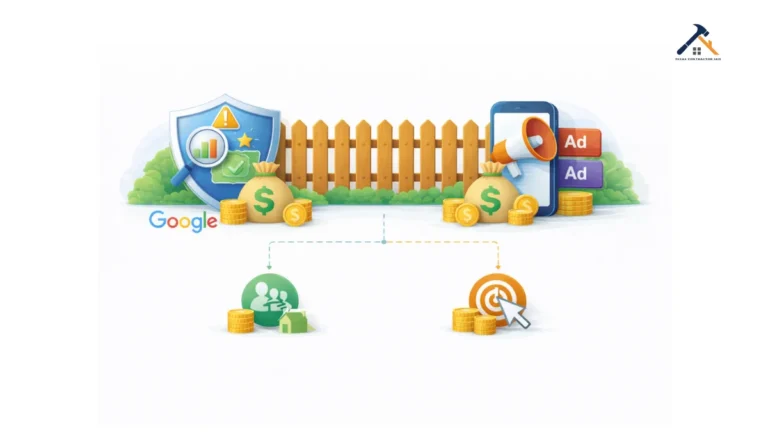


Residential and commercial fencing searches operate as two distinct demand systems. Although both involve fence installation and repair, the way buyers search, evaluate options, and move toward contact differs sharply based on who is making the decision and why the fence is needed.
Residential fencing searches are driven by homeowners responding to immediate needs such as privacy, pets, property boundaries, or HOA requirements. Commercial fencing searches are initiated by business owners, property managers, or contractors working within defined project scopes and approval processes.
These differences shape keyword behavior, search volume patterns, and conversion paths. This article analyzes how residential and commercial fencing SEO diverge at the intent level, why keyword volume behaves differently across the two markets, and how search readiness signals change depending on buyer type.
How does residential fencing search behavior differ from commercial fencing search behavior?
Residential fencing searches are driven by individual homeowners reacting to personal or property-related triggers. These searches tend to be repetitive, local, and emotionally motivated, reflecting uncertainty about options and timing rather than a fixed project plan.
Homeowners often search multiple times across short periods. Queries evolve from broad phrases like fencing companies near me into material or repair-specific terms as understanding improves. The same user may search several variations before making contact.
Commercial fencing searches behave differently because they originate from defined projects. Buyers usually search after scope, fence type, and purpose are already established. The language is more precise and less repetitive because the decision is tied to an approved need rather than exploration.
This difference changes search frequency and structure. Residential demand regenerates constantly as new homeowners encounter similar problems. Commercial demand appears in fewer but more concentrated bursts tied to specific sites or contracts.
Search behavior therefore reflects buyer context. Residential queries signal discovery and comparison, while commercial queries signal evaluation of execution readiness rather than problem definition.
Why do residential fencing keywords generate higher volume but lower intent certainty?
Residential fencing keywords generate higher search volume because homeowner needs recur frequently and are shared across many similar properties. Issues like privacy fencing, pet containment, property boundaries, and HOA compliance affect large numbers of households at different times, creating constant query regeneration.
These searches often mix multiple intent stages. A homeowner may search fence installation near me, wood fence options, and fence repair cost within the same decision window. The language reflects exploration rather than commitment, which lowers certainty even as volume rises.
Residential searches are also influenced by emotional and situational triggers. Concerns about safety, aesthetics, or resale preparation push people to browse options before confirming timing or budget. This behavior inflates keyword volume without guaranteeing immediate contact.
Because many homeowners share similar questions, keywords repeat across users. However, each search represents a different stage of readiness. High volume therefore signals broad interest, not uniform hiring intent.
Residential fencing keywords trade certainty for scale. They capture widespread demand but require additional filtering before intent collapses into contractor outreach.
Why do commercial fencing keywords show lower volume but clearer project intent?
Commercial fencing keywords show lower search volume because fewer buyers initiate them, but each search usually represents a defined project rather than general interest. These queries are tied to business properties, industrial sites, or institutional facilities with specific fencing requirements already approved.
Commercial searches use precise language. Terms referencing security fencing, access control, perimeter fencing, or height and material specifications indicate that scope and purpose are already established. The buyer is not exploring options but validating capability.
Decision authority also narrows search behavior. Property managers, general contractors, and facility owners search less frequently because they already understand fencing fundamentals. They search to confirm fit, compliance, or availability rather than to learn.
Commercial fencing demand appears in concentrated bursts. A single development, warehouse, or multi-tenant property generates a short window of high-intent searches, then disappears once the project advances.
Lower volume therefore reflects efficiency, not weakness. Commercial fencing keywords compress intent into fewer searches, making each query a stronger signal of readiness to engage a contractor.
How do decision timelines differ between residential and commercial fencing searches?
Residential fencing searches tend to move quickly once uncertainty resolves. Homeowners often progress from browsing to contact within a short window because the decision affects daily life, property use, or compliance with HOA rules and local ordinances.
The decision path is usually linear. One or two decision makers compare materials, aesthetics, and basic pricing, then move directly to contractor outreach once a preferred option is identified.
Commercial fencing searches follow longer, staged timelines. Buyers operate within approval chains that may include property ownership, facility management, security planning, and budget authorization. Each layer slows progression from search to contact.
Commercial timelines also reflect coordination with other project elements. Fencing may depend on site access, utility placement, or construction sequencing, which delays immediate action even when intent is clear.
Timeline differences therefore shape search behavior. Residential searches compress into fast decisions driven by personal need, while commercial searches unfold over longer periods governed by process, accountability, and project alignment.
Why does local SEO matter more for residential fencing than commercial fencing?
Local SEO signals play a larger role in residential fencing searches because homeowners expect nearby contractors who can respond quickly and are familiar with local conditions. Proximity, visibility in local results, and recognizable service areas influence trust at the point of contact.
Residential buyers often use near me searches, city names, or neighborhood references. These modifiers reflect assumptions about faster estimates, easier scheduling, and accountability within the same community.
Commercial fencing searches rely less on proximity and more on capability. Buyers prioritize experience with commercial-grade materials, security standards, and regulatory compliance over physical distance. A contractor operating across a wider region can still meet expectations if scope and credentials align.
Local SEO still matters for commercial work, but it functions differently. Instead of signaling convenience, it signals operational presence and legitimacy within a market.
Local relevance therefore carries different weight. For residential fencing, it reassures speed and familiarity. For commercial fencing, it supports credibility without being the primary decision driver.
How do landing page expectations differ for residential versus commercial fencing traffic?
Residential fencing traffic expects reassurance, clarity, and visual confirmation. Homeowners look for project photos, material examples, neighborhood familiarity, and clear explanations that reduce uncertainty around appearance and fit.
Residential landing pages are scanned quickly. Visitors want to confirm that the company installs the type of fence they need and serves their area. Signals like reviews, before-and-after images, and simple service descriptions support fast trust formation.
Commercial fencing traffic expects specificity and proof of capability. Buyers look for project scope descriptions, fence specifications, security applications, and evidence of experience with similar properties or industries.
Commercial visitors spend more time evaluating detail. They assess whether the contractor can meet code requirements, handle larger sites, and coordinate within a broader project framework.
Landing page expectations therefore diverge by buyer type. Residential traffic seeks confidence and relatability, while commercial traffic seeks validation of competence, scale, and execution readiness.
How residential and commercial fencing SEO evolve as separate demand systems
Residential and commercial fencing searches develop along different paths because they are driven by different decision pressures. Residential fencing demand renews continuously as homeowners encounter privacy, safety, and property-boundary needs, creating steady search repetition with mixed readiness levels.
Commercial fencing demand evolves through project cycles rather than daily use. Searches appear when properties move into planning, compliance, or construction phases, then disappear once execution begins. This produces lower volume but more stable intent signals over time.
As these systems mature, their search language stabilizes in different ways. Residential keywords remain broad and regenerative, while commercial keywords remain narrow and scope-defined. Treating them as separate ecosystems allows search behavior to be interpreted correctly without conflating volume with readiness.
Over the long term, fencing SEO performance depends on aligning with these distinct demand mechanics. Residential and commercial fencing searches do not converge; they continue to operate as parallel systems shaped by who is searching, why the fence is needed, and how decisions are made.
Residential and commercial fencing keywords signal different forms of readiness
Residential and commercial fencing keywords express readiness in different ways. Residential searches signal personal urgency and proximity, while commercial searches signal project definition and organizational alignment.
Why do residential fencing searches collapse faster into contractor contact?
Residential fencing searches are driven by immediate personal needs such as privacy, pets, or compliance. Once a homeowner recognizes the problem and identifies a preferred fence type, the decision window narrows quickly and contact follows without extended internal review.
Why do commercial fencing searches remain informational longer before contact?
Commercial fencing searches often occur before final authorization. Buyers may be validating specifications, security requirements, or vendor capability while approvals and coordination with other project elements are still in progress.
How does scope definition replace proximity in commercial fencing keywords?
Commercial fencing keywords emphasize fence height, materials, and function rather than distance. This language signals that execution capability matters more than travel time, reducing the role of hyperlocal modifiers in contractor selection.
Why do mixed-intent residential fencing keywords inflate volume without readiness?
Residential fencing keywords combine browsing, comparison, and hiring stages into the same phrases. This creates high volume even though many searches are still resolving timing, budget, or material uncertainty.
How does buyer accountability shape fencing keyword language?
Commercial buyers search with responsibility for outcomes, budgets, and compliance. Their keyword language reflects risk management and specification accuracy, while residential language reflects personal preference and convenience.
How residential and commercial fencing search behavior diverges over time
Residential and commercial fencing searches continue to evolve along separate tracks because they respond to different renewal forces. Residential fencing demand regenerates through homeowner turnover, property changes, and lifestyle needs, keeping search volume high even when intent varies widely.
Commercial fencing demand renews through development, compliance, and operational change rather than personal urgency. Searches remain less frequent but more stable in language because they are tied to defined project requirements instead of recurring household concerns.
Over time, this divergence becomes structural. Residential fencing SEO rewards visibility across broad, repetitive queries, while commercial fencing SEO aligns with narrower, scope-defined searches that appear only when execution is approaching.
These systems do not converge as markets mature. They remain parallel demand environments shaped by who initiates the search, how decisions are authorized, and what level of certainty exists when keywords are used.