
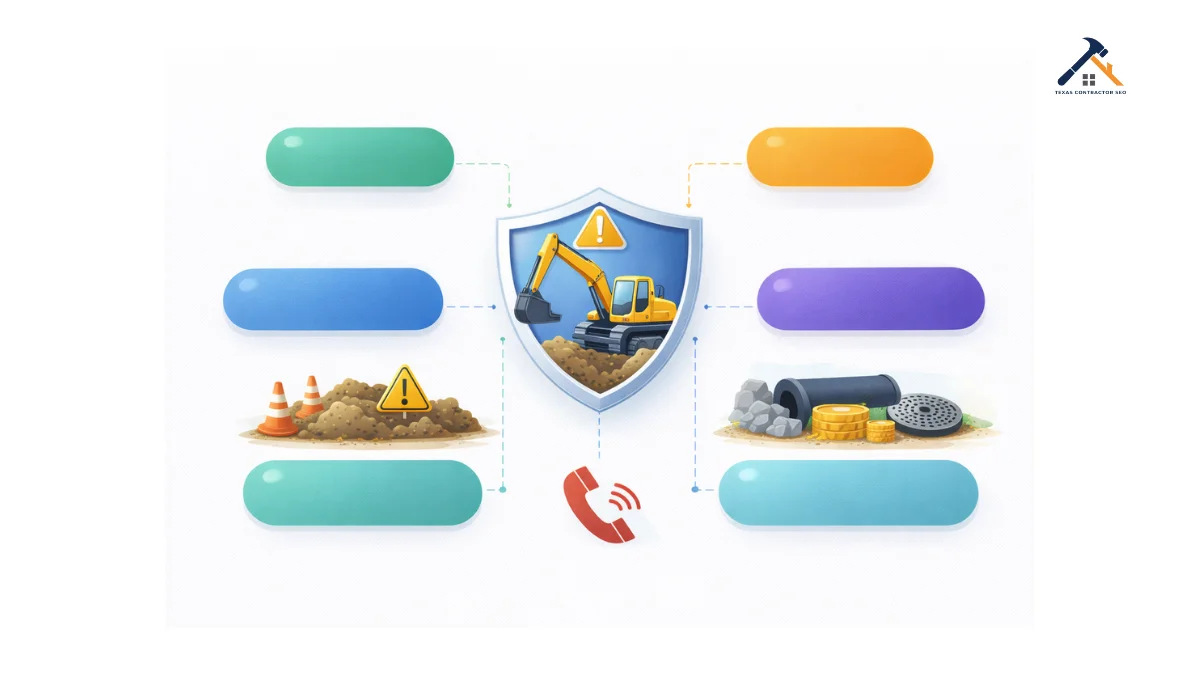

Excavation keywords convert when they reflect a project that is already moving toward execution. These searches do not explore whether excavation is needed. They appear when scope, location, and timing are sufficiently defined for contractor selection to begin.
Unlike broad construction terms, excavation queries often embed task detail and urgency. The language points to grading, trenching, or site preparation work that must occur before any downstream construction can proceed.
This article analyzes which excavation keyword patterns consistently correlate with conversion. It explains how task specificity, project readiness, and buyer role shape search behavior that leads directly to contractor contact rather than extended research.
Which excavation keyword types most often signal hire-now intent?
Hire-now excavation keywords appear when a project has crossed into execution and contractor selection is required. These searches combine service action, location clarity, and task definition, leaving little ambiguity about whether work will proceed.
The strongest signals come from service-driven phrases. Queries that include excavation contractor, site work company, or grading contractor assume the buyer is ready to engage a provider rather than learn about the process.
Geographic anchoring further increases intent density. City or corridor modifiers narrow the search to reachable crews and imply expectations around availability and mobilization timing.
Task language removes remaining uncertainty. Keywords referencing land clearing, mass grading, or utility trenching describe work that must occur before construction can continue.
Together, these keyword types function as execution triggers. They signal that the search is no longer exploratory and that hiring activity is imminent.
How do specific task modifiers influence excavation keyword conversion?
Excavation keywords convert more consistently when they describe a precise task rather than a general capability. Task modifiers reduce ambiguity by signaling that scope, equipment needs, and sequencing are already understood by the buyer.
Terms such as hydrovac excavation, rock excavation, or utility trenching imply that preliminary evaluation has been completed. The buyer is not comparing excavation types but searching for a contractor equipped to perform a known operation.
This specificity filters out early-stage searches. Only projects that have encountered defined site conditions or engineering requirements generate task-modified queries.
Task language also shortens the decision window. Once a constraint like rock, depth, or utility proximity is identified, excavation becomes time-sensitive and blocks downstream work.
As a result, task-modified excavation keywords concentrate conversion value. They reflect projects where uncertainty has collapsed into execution requirements and contractor outreach follows quickly.
Why do long-tail excavation keywords with geographic modifiers convert better than short broad terms?
Long-tail excavation keywords convert at higher rates because they combine task intent with location certainty. These searches describe work that must happen in a specific place, which narrows the contractor pool and accelerates decision-making.
Broad terms like excavation services leave too much open. They attract mixed intent, including research, capability checks, and early planning. Adding a geographic modifier removes that ambiguity.
Phrases that include a city, industrial area, or development corridor imply expectations around mobilization distance and permitting familiarity. The buyer is searching for a contractor who can operate locally without delay.
Geographic specificity also reflects scheduling pressure. When excavation is tied to a known site, timing becomes critical and comparison behavior shrinks.
As a result, long-tail location-based keywords align closely with hire-now behavior. They indicate a defined project where contractor selection is already underway rather than hypothetical evaluation.
How does project readiness affect the quality of excavation keyword conversions?
Excavation keywords convert best when they appear at moments of project readiness rather than early planning. These searches occur after surveys, engineering, and approvals have aligned, leaving excavation as the next blocking task before construction can proceed.
Early-stage projects generate abstract language about land use or feasibility. Conversion-oriented searches reference site preparation, grading schedules, or excavation timelines, which assume mobilization is imminent.
Project readiness compresses the search window. Buyers are no longer gathering options but confirming availability and capacity for a defined scope.
This timing reduces lead noise and increases economic value per inquiry. Each search corresponds to a project that must move forward to avoid cascading delays.
As readiness increases, keyword language becomes more operational. Conversion quality rises because excavation is no longer optional but required for execution.
Which intent signals differentiate conversion-oriented excavation keywords from general research terms?
Conversion-oriented excavation keywords contain action and commitment signals rather than curiosity language. These searches assume that excavation will happen and focus on execution details instead of explanations or comparisons.
Action verbs are a primary indicator. Terms like hire, contractor, site work, or grading company shift the search from learning to procurement.
Scope clarity further separates intent. Keywords that reference acreage, cut and fill, or haul-off imply that quantities and constraints are already known.
Timing language also matters. Searches that include availability, schedule, or start date indicate urgency tied to construction sequencing.
Research terms avoid these signals. They ask what excavation involves or how it works. Conversion-oriented keywords direct the search toward who can perform the work and how soon it can begin.
Excavation keywords that convert cluster around task definition and urgency
Excavation keywords convert when they describe work that must happen next in the construction sequence. These clusters combine defined tasks, site certainty, and schedule pressure that removes extended comparison behavior.
Why does urgency in excavation searches reduce contractor comparison?
Urgent excavation searches appear when site work blocks foundations, utilities, or paving. Schedule pressure narrows evaluation to availability and capacity rather than extended bid comparison.
Why do execution-stage excavation keywords outperform planning-stage excavation terms?
Execution-stage excavation keywords appear only after permits, engineering, and funding are complete. Planning-stage terms reflect feasibility, while execution terms reflect work that must begin to avoid project delays.
How does site-specific wording increase excavation keyword conversion?
Excavation searches that reference a specific site, parcel, or development area reduce the eligible contractor pool. Fewer viable options increase intent density and shorten the decision window.
Why do excavation keywords tied to blocking tasks convert faster?
Excavation blocks all downstream construction trades. Keywords tied to grading, mass excavation, or trenching signal work that must start immediately for the project to proceed.
How does task certainty affect excavation hiring behavior?
When excavation keywords describe a fixed task with known conditions, the search shifts from exploration to procurement. Contractor outreach follows because uncertainty has already collapsed.
How conversion-oriented excavation search behavior reflects project execution certainty
Excavation keywords that convert consistently describe work that is unavoidable and time-bound. Search behavior shifts only after scope, location, and sequencing are fixed, which explains why volume stays low while economic value stays high.
These queries do not compete with broad construction terms. They appear at the moment when excavation becomes the gating task that determines whether a project can move forward.
Over time, this creates a stable pattern. Conversion is driven by execution certainty rather than curiosity, and keyword performance aligns more closely with project readiness than with traffic scale.
Excavation search therefore functions as a proxy for mobilization. When the language becomes specific and urgent, hiring intent is already present, and search acts as a final confirmation step before contractor engagement.