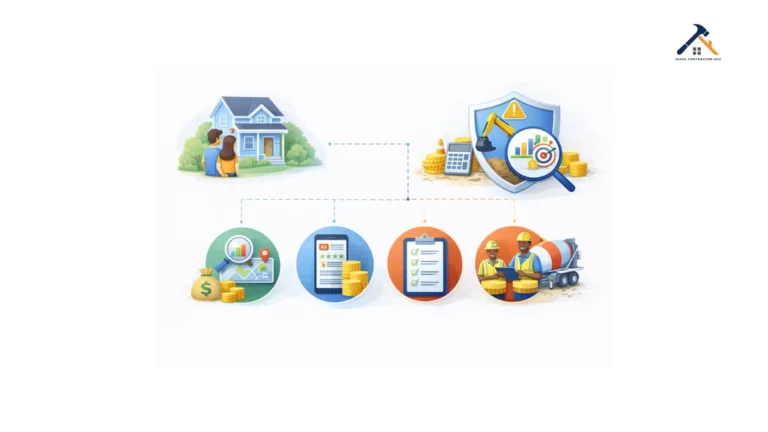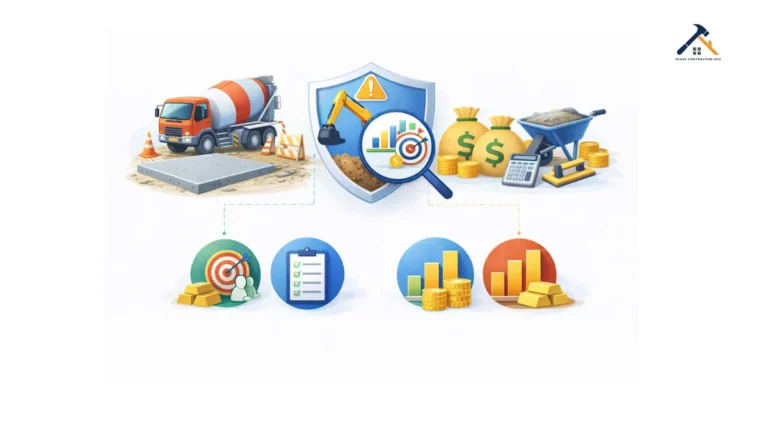


Searches for concrete work almost always narrow to a specific place. Homeowners start with a service like a driveway or patio, then quickly add a city or “near me” to find a contractor close to the project site. Distance feels risky when the job is permanent and highly visible.
Trust forms from what people can see nearby. Finished concrete on the same street or in the same neighborhood carries more weight than impressive projects across town. Local familiarity signals reliability, availability, and understanding of ground and drainage conditions.
Because each Texas city functions as its own competitive environment, visibility must be built locally rather than regionally. What works in Houston does not automatically earn trust in Dallas, Austin, or San Antonio without nearby proof of work.
Table of Contents
Why homeowners add location terms to concrete searches
Once homeowners decide on a concrete driveway, patio, or slab, they narrow results to contractors who work nearby. Adding a city name or “near me” filters out distant providers who may not serve the exact area.
Location terms signal practical concerns. Homeowners expect a local concrete contractor to arrive quickly, understand neighborhood rules, and return easily for follow-up work if needed.
These searches also reflect familiarity. Seeing nearby trucks, signs, or completed concrete projects makes local companies feel more accountable and reachable.
In large Texas metros like Houston, adding the neighborhood or suburb reduces uncertainty about scheduling and travel time. Proximity becomes part of the decision, not just the service type.
Local wording therefore turns general intent into an actionable shortlist. Naming the place ensures the chosen concrete company operates where the project actually sits.
How proximity influences which concrete contractor gets contacted
Homeowners favor the closest credible concrete contractor because distance affects response time and accountability. A nearby crew feels easier to schedule, easier to supervise, and easier to reach if adjustments are needed after the pour.
Short travel also suggests familiarity with local conditions. Contractors who regularly work in the same area understand typical soil movement, drainage patterns, and permit expectations for concrete driveways and patios.
Proximity reduces perceived risk. A company based across the city feels harder to revisit if a joint needs sealing or an edge requires correction. Nearby providers feel more dependable for follow-up care.
In dense cities like Dallas, many capable firms compete within small radii. Homeowners often contact the closest one that shows strong, recent concrete projects in the same part of town.
Being near the job site therefore increases the chance of first contact. Distance quietly filters options even before quality comparisons begin.
Why nearby completed concrete projects build stronger trust
Homeowners trust results they can see in person. A finished concrete driveway on the next street carries more credibility than a distant portfolio image because it proves the contractor works successfully in the same environment.
Nearby projects show how surfaces perform over time. Seeing clean edges, stable joints, and good drainage on familiar properties reduces uncertainty about durability.
Local examples also match context. Lot size, slope, and home style in the same neighborhood make it easier to imagine a similar concrete patio or sidewalk at one’s own property.
Word-of-mouth spreads faster around visible work. Neighbors share who poured the slab and how the process went, which reinforces trust in that specific concrete company.
In growing areas of Houston and Austin, repeated exposure to nearby installs steadily narrows choices to contractors with proven local results.
How each Texas city behaves like a separate concrete market
Concrete demand and competition reset at city boundaries. A contractor well known for concrete driveways in Houston does not automatically carry the same recognition or trust in Dallas.
Local conditions differ. Soil movement, drainage needs, and permitting practices vary by city, which shapes how homeowners evaluate a concrete contractor for slabs and patios.
Project visibility is also city-specific. Photos and references from one metro feel less relevant to homeowners in another who want proof of nearby concrete installations.
Competition follows the same pattern. Each city has its own group of established concrete companies continuously adding new projects and local proof.
Because of this separation, visibility must be earned independently in Austin, San Antonio, Dallas, and Houston. Success in one market does not transfer by default to the next.
Why neighborhood-level reputation outweighs distant credentials in concrete contractor selection
Homeowners trust a concrete contractor who is repeatedly visible in their own area. Seeing multiple nearby concrete driveways or patios from the same company signals dependable results under the same soil, drainage, and layout conditions.
Local reputation is easier to verify. Neighbors share direct experiences about scheduling, cleanup, and durability, which carries more weight than distant awards or out-of-town projects.
Familiarity also implies accountability. A contractor who works often in the same streets is easier to revisit for adjustments to a concrete slab or joint sealing if needed.
In neighborhoods around Dallas and San Antonio, repeated exposure to the same finished work builds quiet consensus about quality.
Nearby proof closes the trust gap faster than impressive but faraway credentials.
How travel distance shapes concrete contractor availability and response expectations
Homeowners assume a nearby concrete contractor can start sooner and return more easily for follow-up work. Shorter travel reduces delays in site visits, measurements, and scheduling for a new concrete driveway or patio.
Distance also affects daily logistics. Crews based closer to the job can mobilize equipment faster and adjust timelines if weather or curing conditions change.
Availability feels more predictable with local providers. A company working across the metro may juggle distant projects, while a nearby crew appears focused on the same area.
In large cities like Houston, travel time can vary widely by neighborhood. Choosing a closer concrete company reduces uncertainty about arrival windows and revisit needs.
Proximity therefore shapes expectations of speed and reliability, not just price or finish.
Why visibility for concrete contractors in one Texas city does not transfer to another
Homeowners judge a concrete contractor by nearby proof, not by regional presence. Strong visibility for concrete driveways in Austin does not automatically earn trust for the same contractor in Houston.
Each city has its own set of visible projects, local reviews, and familiar company names. Homeowners search for results that match their own streets and conditions, not distant concrete installations.
Competition is also city-specific. Established concrete companies in Dallas or San Antonio continuously add new local work, which resets the comparison for anyone searching there.
Travel distance reinforces the divide. A contractor based in another metro feels harder to schedule and revisit for a concrete slab adjustment if needed.
Because trust forms from local repetition, recognition must be rebuilt city by city. Success in one Texas market does not automatically create credibility in another.
How hyper-local relevance drives driveway, patio, and slab inquiries
Homeowners contact a concrete contractor when they see proof that the same type of work succeeded nearby. A finished concrete driveway, patio, or slab in the immediate area makes the outcome feel predictable on their own property.
Hyper-local relevance links service type to place. Searches combine the surface and the neighborhood so results show contractors who repeatedly build similar concrete installations close by.
Recent nearby projects also signal availability. Seeing fresh work on the same streets suggests crews are active and familiar with local access, permits, and curing conditions.
In fast-growing parts of Austin and Houston, clusters of new pours trigger concentrated inquiries for the same surfaces within a small radius.
Proximity plus matching project type turns browsing into outreach.
Geographic and social forces that anchor concrete searches to neighborhoods
Concrete decisions depend on nearby proof of work and local familiarity. These forces keep searches focused on specific neighborhoods and cities rather than broad regional providers.
How local soil and drainage conditions influence contractor choice
Homeowners prefer a concrete contractor who regularly builds on the same ground type. Nearby concrete slabs that remain level and drain well signal practical understanding of local soil movement.
Why neighborhood word-of-mouth accelerates local concrete searches
Recommendations spread quickly when a visible concrete driveway or patio turns out well. Shared experiences push more homeowners in the same area to search for that specific local concrete company.
How visible street-level concrete projects trigger same-area inquiries
Passing a freshly poured concrete installation on daily routes reinforces the idea to upgrade. Familiar results reduce hesitation and concentrate searches around that exact part of town.
Why city growth patterns create pockets of concentrated concrete demand
New developments and renovations cluster by area. In expanding zones of Dallas and San Antonio, multiple nearby pours create waves of localized concrete contractor inquiries.
How hyper-local concrete search behavior should be interpreted over time
Concrete searches cluster around immediate geography because trust grows from nearby, repeatable results. Homeowners return to the same local examples over weeks or months before contacting a concrete contractor.
Each city and neighborhood forms its own cycle of visibility and comparison. New concrete driveways, patios, and slabs create short waves of same-area inquiries as residents see proven work close to home.
Recognition must be rebuilt block by block. Success in one part of Houston or Dallas does not automatically influence choices a few miles away without visible local proof.
Over time, repeated exposure narrows options quickly. Once proximity and familiarity align, outreach concentrates to the closest credible concrete company rather than distant alternatives.