
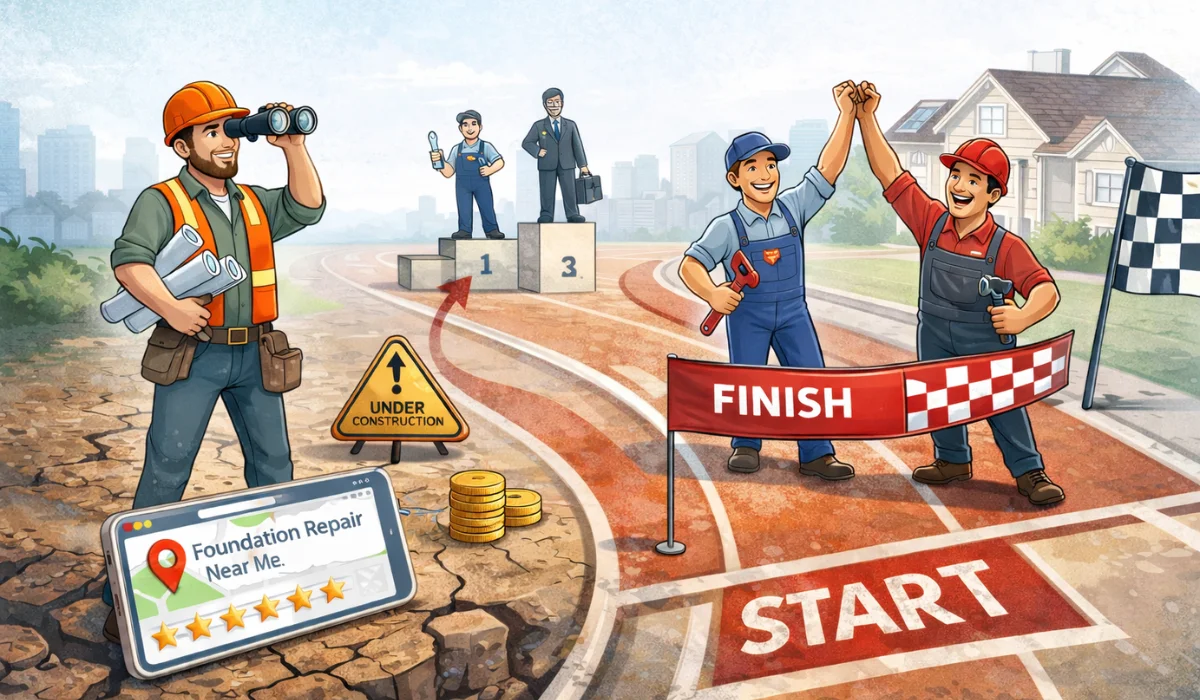

Many contractors compare SEO timelines across industries and assume the process should work the same for everyone. A plumber can start getting calls within a few months. A roofing company can gain traction quickly after a storm season. But foundation repair companies often see slower progress, especially in competitive markets like Dallas, Houston, and Austin.
The difference is not caused by poor SEO performance. It comes from how Google evaluates risk, trust, and decision complexity in different services. Foundation repair is not a quick-fix job. It involves structural integrity, higher costs, and long-term consequences. Because of that, both search engines and homeowners approach it with more caution.
This changes everything about how SEO works. Rankings take longer to build. High-intent keywords are harder to win. Local competition is more aggressive. And most importantly, homeowners do not make decisions immediately—they research, compare, and validate before choosing a contractor.
Understanding why this happens is critical. Without that clarity, many contractors assume SEO is slow or ineffective, when in reality, it is behaving exactly as expected for a high-trust, high-stakes service category.
This article breaks down the real reasons foundation repair SEO takes longer than other trades—and what that means for contractors trying to generate consistent leads from search.
Table of Contents
Why Does Foundation Repair SEO Take Longer Than Other Trades?
Foundation repair SEO takes longer because it operates under stricter trust requirements, higher financial stakes, and more complex decision-making compared to most trades.
In trades like plumbing or HVAC, many searches are driven by urgency. A burst pipe or a failed AC unit creates immediate action. Users search, click, and call quickly. Google sees fast engagement and clear intent, which allows rankings to stabilize faster.
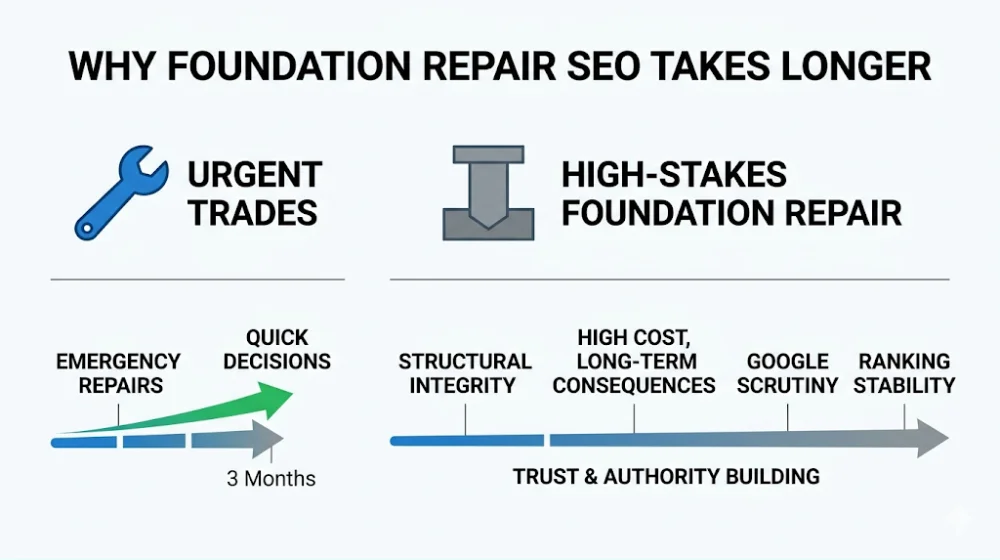
Foundation repair does not follow that pattern.
It falls into a high-risk, high-consideration trade category. Homeowners are not making a quick fix—they are dealing with structural integrity. The cost is significantly higher, the consequences of a wrong decision are serious, and the process often involves inspections, quotes, and comparisons.
Because of this, Google applies a different level of scrutiny.
Ranking a foundation repair company is not just about relevance. It is about proven trust and authority:
- Depth of content across structural issues
- Strong review signals and reputation
- Clear expertise in repair methods and outcomes
Until these signals are established, rankings move slower—especially in competitive markets like Dallas and Houston.
User behavior further reinforces this delay. Unlike other trades, homeowners typically:
- Research multiple causes of foundation damage
- Compare repair methods such as slab stabilization or pier systems
- Evaluate cost ranges and long-term impact
- Review multiple contractors before making a decision
This extended research phase reduces immediate conversions. Lower early engagement signals mean Google takes longer to confidently push rankings upward.
Another factor is keyword concentration. In many trades, demand is spread across different services. In foundation repair, the most valuable keywords are tightly grouped and highly competitive:
- “foundation repair near me”
- “foundation contractor”
- “slab repair”
This concentration increases competition and slows ranking progression.
The difference comes down to how each trade behaves:
- Faster trades rely on urgency and immediate action
- Foundation repair relies on trust, validation, and deeper evaluation
This is why SEO timelines extend. Not because the strategy is slow, but because the barrier to rank—and convert—is significantly higher in this trade.
How Is Foundation Repair Different from Plumbing, Roofing, and HVAC in Search Behavior?
The biggest difference between foundation repair and other trades is not just competition—it is how people search, evaluate, and decide.
In trades like plumbing or HVAC, search behavior is driven by urgency. A leaking pipe or broken air conditioner creates immediate discomfort. Users search for terms like:
- “emergency plumber near me”
- “AC repair near me”
and often call the first or second result they trust. The decision cycle is short, and Google sees quick clicks, fast calls, and immediate conversions. This reinforces rankings faster.
Foundation repair follows a completely different pattern.
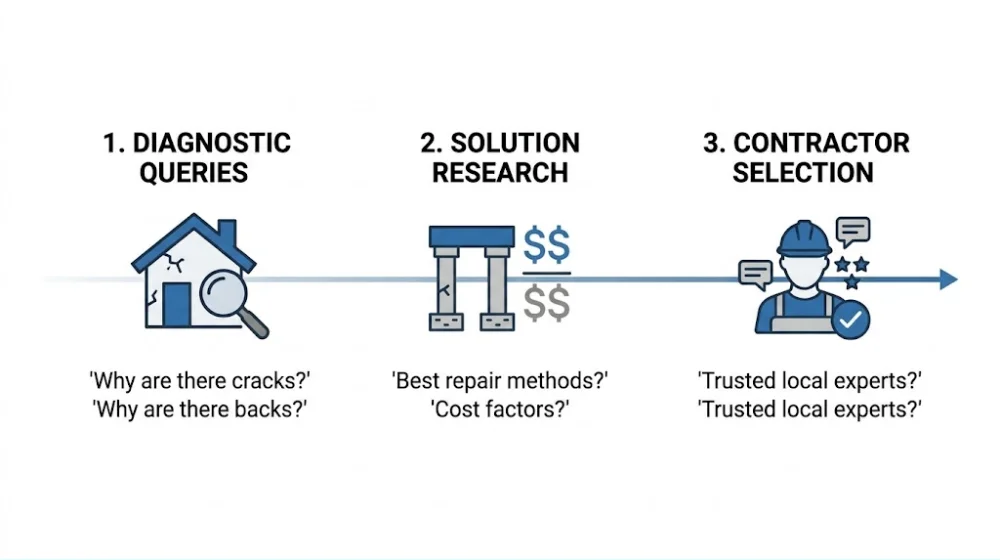
Searches begin earlier in the problem cycle and move through multiple stages before any hiring decision is made. A homeowner in Austin or Dallas may not even search for a contractor initially. Instead, they start with:
- “why are there cracks in my foundation”
- “is foundation settling dangerous”
- “how much does foundation repair cost”
These are informational and diagnostic queries, not service queries.
This creates a layered search journey:
- Early stage: problem awareness and cause identification
- Mid stage: solution comparison and cost evaluation
- Late stage: contractor selection and hiring
Each stage involves different keywords, different expectations, and different types of content.
Because of this, foundation repair SEO requires coverage across the entire journey, not just service pages. If a website only targets high-intent keywords, it misses the earlier stages where trust begins to build.
Roofing sits somewhere in between. In emergency cases like storm damage, behavior becomes urgent. But for planned replacements, users may still compare options. Plumbing and HVAC lean heavily toward urgency. Foundation repair leans heavily toward deliberation.
This difference impacts SEO in two major ways.
First, engagement signals take longer to develop. Users may visit multiple pages, leave, return later, and only convert after several interactions. Google interprets this as a longer decision cycle, which slows ranking acceleration.
Second, authority must be built across multiple topic layers. Google expects to see:
- Problem explanations
- Cause analysis
- Repair methods
- Cost breakdowns
- Service pages
Without this depth, the site appears incomplete compared to competitors who cover the full search journey.
What this means is simple:
In faster trades, rankings grow from quick actions and immediate intent.
In foundation repair, rankings grow from progressive trust built across multiple searches.
That shift in behavior is one of the main reasons SEO timelines are longer—and why strategies that work in other trades often fail when applied here.
Why High-Ticket Services Like Foundation Repair Require More SEO Trust Signals
Foundation repair is not just another service—it is a high-ticket decision with long-term consequences. This single factor changes how both users and Google evaluate businesses, and it is one of the main reasons SEO takes longer compared to other trades.
In lower-cost trades, the risk of making the wrong choice is limited. If a plumbing repair is not perfect, the issue can usually be fixed again with minimal long-term impact. Because of that, users are more willing to act quickly, and Google can rank businesses with fewer trust signals.
Foundation repair operates at a completely different level.
The cost is higher, often ranging into thousands or tens of thousands of dollars. More importantly, the outcome directly affects the structural stability of a home. A poor repair decision can lead to recurring damage, reduced property value, and long-term complications.
Because of this, Google requires stronger validation before ranking a business for high-intent searches.
These trust signals include:
- Content depth and expertise: Pages must go beyond basic service descriptions. They need to explain repair methods, causes of damage, and expected outcomes in detail.
- Reputation through reviews: A strong Google Business Profile with consistent, high-quality reviews signals reliability and real-world experience.
- Backlinks and external authority: Mentions from other websites act as third-party validation, reinforcing credibility.
- User engagement signals: When users spend time reading, exploring multiple pages, and returning later, it indicates trust-building behavior.
In cities like Houston and Dallas, where competition is already strong, these signals must not only exist—they must compete with businesses that have built them over years.
Another important difference is how users respond to trust signals.
For high-ticket services, homeowners rarely choose a company based on a single interaction. They:
- Compare multiple providers
- Read reviews in detail
- Evaluate expertise and process
- Look for consistency across website and local presence
This behavior means that even if your site ranks, conversion depends on how well these trust signals are communicated.
From an SEO perspective, this creates a higher threshold:
- More content is required
- More authority is needed
- More validation must be visible
This is why timelines extend. Google is not just ranking relevance—it is ranking confidence in your ability to handle a critical service.
In faster trades, visibility can lead to immediate action.
In foundation repair, visibility must first translate into trust—only then does it convert into leads.
How Google Evaluates Riskier Trades Differently in Search Results
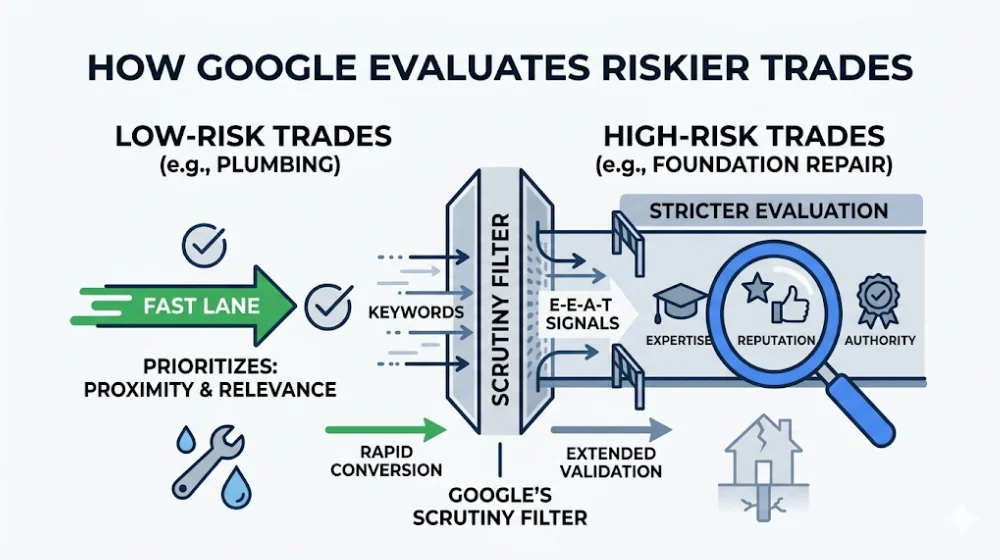
Not all trades are treated equally in search results. Google applies different levels of scrutiny depending on how much risk, cost, and long-term impact a service carries. Foundation repair falls into a category where mistakes can have serious consequences, which changes how rankings are evaluated.
In lower-risk trades, Google can rely more on basic signals like keyword relevance and proximity. If a user searches for a plumber, the primary goal is to connect them quickly with a nearby provider. The decision is urgent, and the risk is relatively contained.
Foundation repair does not fit that model.
Here, Google prioritizes accuracy, reliability, and proven expertise over speed. This means rankings depend more heavily on signals that demonstrate long-term credibility:
- Comprehensive coverage of structural issues and repair methods
- Consistent user engagement across multiple visits
- Strong reputation through reviews and local presence
- External validation through backlinks and citations
This creates a stricter evaluation process.
In competitive markets like Dallas and Houston, Google compares not just individual pages, but entire websites. It looks at how well a business covers the full topic of foundation repair—from early-stage problem identification to final service execution.
Another key difference is how Google handles ranking stability.
In faster trades, rankings can shift quickly based on recent activity or proximity. In foundation repair, movement is more conservative. Google tends to:
- Promote sites gradually
- Test positions before committing to higher rankings
- Maintain established competitors unless a new site clearly demonstrates stronger authority
This slower adjustment cycle is intentional. It reduces the risk of placing unreliable businesses in front of users making high-stakes decisions.
User behavior reinforces this process. When homeowners search for foundation repair, they often:
- Visit multiple websites
- Return to search results
- Compare several options over time
Google interprets this as a longer decision journey, which delays strong ranking signals compared to quick, one-step conversions in other trades.
Another important factor is how local results are filtered. The Google Business Profile plays a major role in determining which businesses appear in the map pack. For riskier trades, Google leans more heavily on:
- Review quality and consistency
- Business activity and engagement
- Relevance of services offered
This makes it harder for newer or less-established businesses to break into top positions quickly.
What this means in practice is clear:
- Google moves faster when the risk is low and decisions are simple
- Google moves slower when the risk is high and decisions require validation
Foundation repair sits firmly in the second category. As a result, SEO timelines extend—not because the system is inefficient, but because the evaluation standards are higher by design.
Why Homeowners Take Longer to Decide on Foundation Repair (And How That Affects SEO)
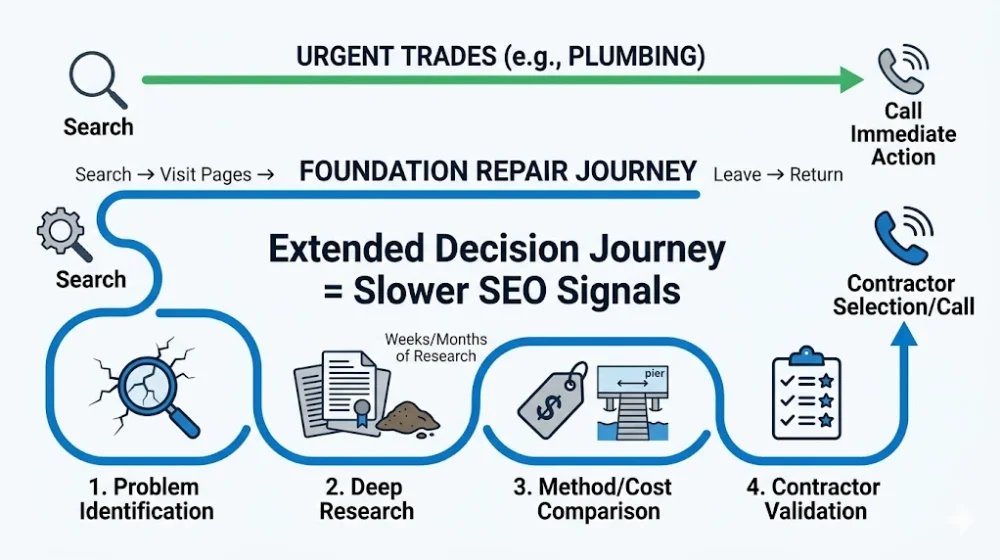
The speed of SEO is closely tied to how quickly users make decisions. In foundation repair, homeowners do not act immediately. They move through a long, cautious evaluation process, and this directly slows down ranking progression.
When a homeowner notices signs like cracks in walls or uneven floors, the first reaction is rarely to hire a contractor. Instead, they try to understand the problem:
- Is this serious or cosmetic?
- What is causing it?
- Does it need immediate repair?
This leads to multiple searches before any buying intent appears.
A typical journey for a homeowner in Austin or Dallas looks like this:
- Initial search: identifying the problem
- Follow-up searches: understanding causes and risks
- Comparison stage: exploring repair methods and costs
- Final stage: selecting a contractor
This process can take days, weeks, or even months depending on the severity of the issue and budget considerations.
In contrast, other trades often skip most of these steps. A plumbing emergency or HVAC failure pushes users directly into action. They search, choose, and call within a single session.
This difference in behavior affects SEO in several ways.
First, engagement signals are delayed. Instead of immediate conversions, users:
- Visit multiple pages
- Leave and return later
- Compare several websites
Google sees this as a longer decision cycle, which slows how quickly it promotes any single site in rankings.
Second, conversion signals are weaker in early stages. Even if your site attracts traffic, users may not call or submit forms right away. This can make performance appear low, even when visibility is increasing.
Third, trust must be built across multiple interactions. Homeowners need to feel confident before making a high-cost decision. This means your website must:
- Provide clear explanations
- Answer multiple layers of questions
- Reinforce credibility through reviews and experience
Without this, users continue searching, and Google delays ranking progression.
Another important factor is comparison behavior. Homeowners rarely choose the first contractor they find. They:
- Check multiple companies
- Read reviews in detail
- Evaluate pricing expectations
- Look for consistency in messaging and expertise
This reduces the likelihood of immediate conversions, which are common in faster trades.
From an SEO perspective, this creates a slower feedback loop:
- Traffic increases before conversions
- Rankings improve before lead flow stabilizes
- Authority builds gradually instead of quickly
What this means is that foundation repair SEO is not just about ranking—it is about supporting a longer decision journey.
In faster trades, SEO aligns with quick decisions.
In foundation repair, SEO must support research, comparison, and validation before action happens.
This extended user journey is one of the core reasons timelines are longer—and why strategies that rely on immediate conversion signals do not work effectively in this trade.
Why Local Map Pack Competition Is Harder for Foundation Repair Contractors
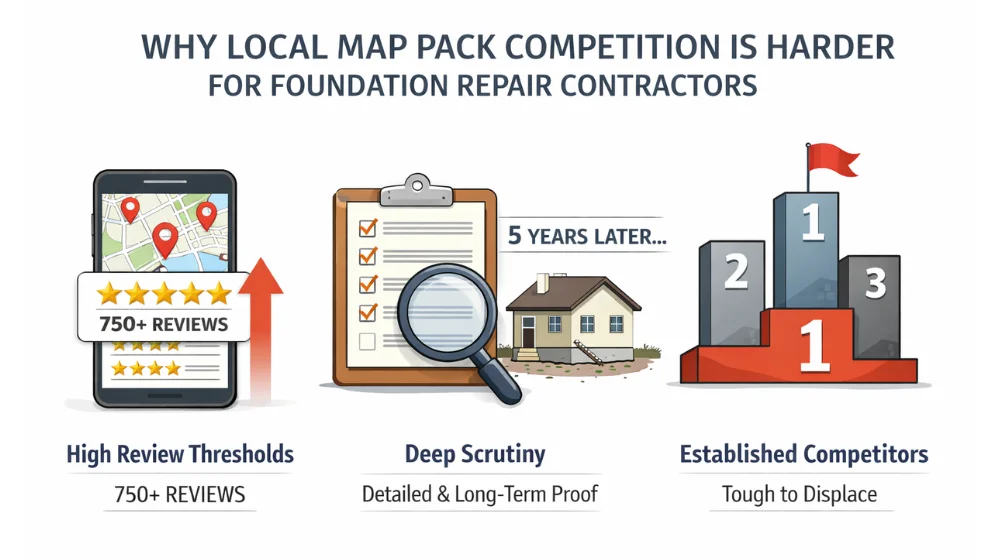
In most trades, showing up in the local map pack is achievable with basic optimization and a steady flow of reviews. In foundation repair, the bar is significantly higher, and this directly impacts how long it takes to generate leads from SEO.
The map pack—driven by your Google Business Profile—is where high-intent searches convert. For queries like “foundation repair near me,” users often choose from the top three listings without scrolling further. That makes these positions extremely competitive.
In trades like plumbing or HVAC, competition is spread across multiple service types. You may have separate searches for leaks, drain cleaning, installations, and repairs. This fragmentation lowers the pressure on any single keyword.
Foundation repair is different.
The majority of demand is concentrated around a small group of high-value keywords:
- “foundation repair near me”
- “foundation contractor”
- “slab repair”
Because of this concentration, every serious competitor is targeting the same space. This creates a crowded and highly competitive map pack environment.
Another key factor is review thresholds.
Top-ranking foundation repair companies in cities like Houston and Dallas often have:
- High review counts
- Consistent review velocity
- Detailed feedback from customers
In other trades, a moderate number of reviews may be enough to compete. In foundation repair, the expectation is higher because users rely heavily on reviews when making a high-cost decision.
Review quality also plays a stronger role. Homeowners look for:
- Detailed descriptions of work performed
- Evidence of long-term results
- Consistency across multiple reviews
This increases the level of scrutiny applied to each business.
Another challenge is service area overlap. Foundation repair companies often operate across multiple cities and regions. This creates situations where several strong businesses compete for visibility in the same geographic area. Google must filter and rotate results based on proximity, relevance, and prominence, making rankings less predictable.
Engagement signals further influence the map pack. Actions like:
- Calls from search results
- Direction requests
- Profile clicks
tell Google which businesses users prefer. In foundation repair, these signals take longer to build because users do not act immediately.
This creates a compounding effect:
- Fewer early conversions
- Slower engagement signal growth
- Delayed improvement in map rankings
Another difference is how difficult it is to displace existing competitors. Businesses that already rank in the top three positions often have:
- Established review profiles
- Strong brand recognition
- Consistent activity over time
Replacing them requires not just optimization, but sustained improvement across multiple signals.
What this means is that ranking in the map pack for foundation repair is not just about being relevant. It is about being trusted at a level comparable to established competitors.
In faster trades, local rankings can shift quickly with new activity.
In foundation repair, movement is slower because the signals required to compete take longer to build.
This is why many contractors see progress in website rankings but struggle to gain visibility in the map pack. Until both systems—website and local profile—reach competitive strength, lead generation remains limited.
Why Foundation Repair Requires Deeper Content Than Other Trades
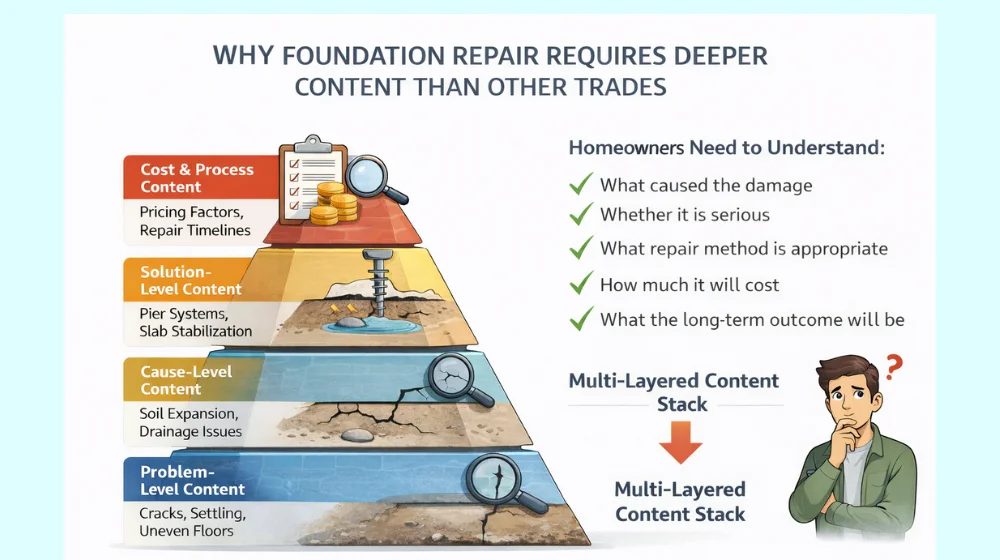
In most trades, a simple service page can rank and convert. A plumbing page explaining leak repair or a basic HVAC service page is often enough because the problem and solution are straightforward.
Foundation repair does not work that way.
The service involves multiple variables, technical explanations, and long-term consequences, which means Google expects a much deeper level of content before assigning strong rankings.
A homeowner does not just search for “foundation repair” and make a decision. They need to understand:
- What caused the damage
- Whether it is serious
- What repair method is appropriate
- How much it will cost
- What the long-term outcome will be
This creates a requirement for multi-layered content, not just service descriptions.
High-performing foundation repair websites typically cover:
- Problem-level content: Cracks, settling, uneven floors, sticking doors
- Cause-level content: Soil expansion, moisture imbalance, drainage issues
- Solution-level content: Pier systems, slab stabilization, structural reinforcement
- Cost and process content: Pricing factors, inspection steps, repair timelines
Each of these layers supports a different stage of the search journey. Without all of them, the site appears incomplete compared to competitors.
In trades like plumbing, many searches are transactional from the start. Users already know they need a service, so they do not require extensive explanation. This allows thinner content to perform well.
In foundation repair, users need to build confidence before taking action. That confidence comes from clear, detailed, and interconnected information.
This also affects how Google evaluates authority.
Instead of ranking a single page, Google looks at how well your entire site covers the topic. It evaluates:
- Depth of explanation
- Breadth of coverage
- Connections between related topics
If your site only has a few pages targeting high-intent keywords, it lacks the supporting structure needed to compete.
Another important factor is content differentiation.
Because foundation repair is competitive, many websites attempt to target the same keywords. Pages that only repeat generic information become interchangeable. Google prioritizes those that provide:
- More detailed explanations
- Better organization of information
- Clearer answers to user questions
This raises the standard required to rank.
The result is a longer content development cycle:
- More pages need to be created
- Existing pages need to be expanded and refined
- Internal linking must connect all topics logically
This takes time, and until it is in place, rankings tend to move slowly.
What this means is simple:
In faster trades, content can be minimal and still perform.
In foundation repair, content must be comprehensive, structured, and deeply informative.
That additional requirement is one of the core reasons SEO timelines are longer—and why shallow content strategies fail in this trade.
How Backlinks and Authority Matter More in Foundation Repair SEO
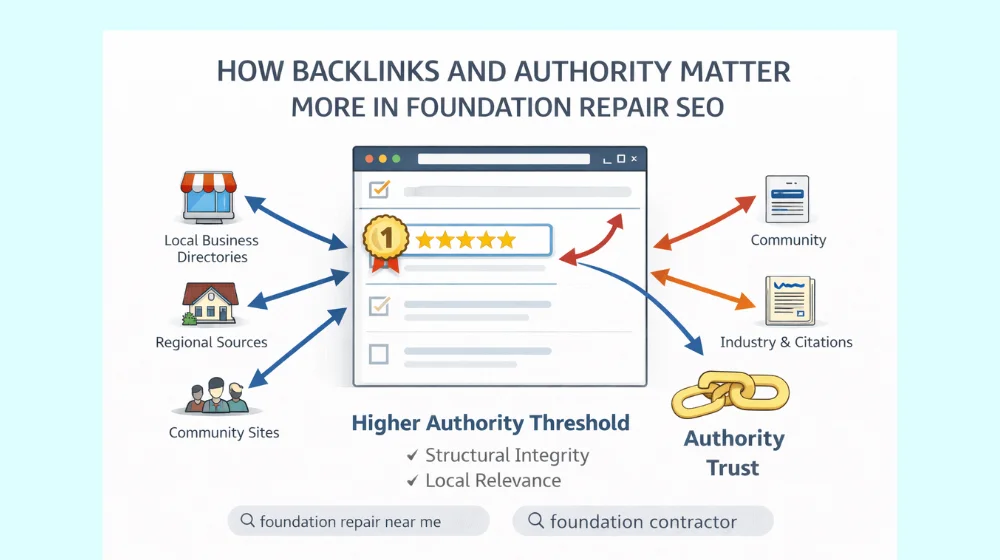
Backlinks influence SEO in every industry, but in foundation repair, they carry more weight because of the higher trust threshold required to rank.
In lower-risk trades, a well-optimized website with decent content can start ranking even with a limited number of backlinks. Google is more willing to test and rotate results because the consequences of a wrong ranking are relatively low.
Foundation repair is different.
Because the service involves structural integrity and high costs, Google relies more heavily on external validation before promoting a business into top positions. Backlinks act as that validation. They signal that other websites recognize your business as credible and relevant.
In competitive markets like Houston and Dallas, top-ranking companies typically have:
- Links from local business directories
- Mentions from regional websites
- Citations across trusted platforms
- Occasionally, coverage from industry-related sources
These signals accumulate over time, creating a level of authority that is difficult for newer websites to match quickly.
Another important factor is competitive benchmarking. Google does not evaluate your site in isolation. It compares your authority directly against competitors already ranking for key terms like:
- “foundation repair near me”
- “foundation contractor”
If your backlink profile is significantly weaker, your site may reach page 2 or lower page 1—but struggle to move beyond that.
Backlinks also influence how quickly Google trusts new content. When a site already has strong authority, newly published pages:
- Get indexed faster
- Rank faster
- Move up more consistently
Without that authority, each new page must prove itself independently, which slows overall growth.
In foundation repair, backlinks are not just about quantity—they are about local and contextual relevance. Links connected to your service area or industry carry more weight because they reinforce both authority and geographic relevance.
Another difference compared to other trades is how backlinks interact with user trust. When users evaluate a foundation repair company, they often look for signs of credibility beyond the website itself. External mentions, citations, and visibility across platforms indirectly support this perception.
This creates a compounding effect:
- Strong backlinks improve rankings
- Better rankings increase visibility
- Increased visibility leads to more engagement and trust
But building this authority takes time.
In faster trades, rankings can grow with minimal external signals.
In foundation repair, backlinks are often the factor that determines whether a site remains on page 2 or breaks into top positions.
This is why SEO timelines extend. Authority cannot be rushed—it must be built, validated, and sustained before Google allows a business to compete at the highest level.
Why You Can Rank Faster in Plumbing but Slower in Foundation Repair
The difference between plumbing SEO and foundation repair SEO becomes clear when you compare how quickly rankings turn into actions.
In plumbing, the majority of searches are urgent. A leaking pipe, clogged drain, or water heater failure creates immediate pressure to act. Users search, click, and call within minutes. Because of this, Google sees:
- Fast engagement
- Immediate conversions
- Clear intent signals
These signals reinforce rankings quickly. Even newer websites can gain traction because user behavior confirms relevance almost instantly.
Foundation repair works in the opposite way.
Searches are rarely urgent. A homeowner noticing cracks or uneven floors does not immediately hire a contractor. Instead, they begin a process of research and validation. This delays:
- Click-to-call actions
- Form submissions
- Strong engagement signals
Without those signals, Google moves rankings more cautiously.
Another key difference is competition structure.
In plumbing, demand is distributed across many services:
- Leak repair
- Drain cleaning
- Pipe replacement
- Emergency services
This spreads competition across multiple keyword groups, making it easier to rank for specific terms.
In foundation repair, demand is concentrated around a smaller set of high-value keywords:
- “foundation repair near me”
- “foundation contractor”
- “slab repair”
This concentration increases competition for each keyword, slowing ranking progression.
Content expectations also differ.
Plumbing pages can rank with relatively simple explanations because the problem and solution are easy to understand. Foundation repair requires:
- Detailed explanations of causes
- Comparison of repair methods
- Cost breakdowns
- Process transparency
Without this depth, pages struggle to compete, even if they are optimized.
Local signals further widen the gap. A plumber can compete in the Google Business Profile with a moderate number of reviews and basic optimization. In foundation repair, competitors in cities like Austin or Houston often have:
- Higher review counts
- Stronger reputation signals
- More established presence
This makes it harder for new entrants to gain visibility quickly.
Backlinks also play a different role. Plumbing websites can rank locally with limited authority. Foundation repair sites often need stronger backlink profiles to compete, especially for high-intent keywords.
When you combine these factors, the difference becomes clear:
- Plumbing SEO benefits from urgency, fragmented demand, and faster user action
- Foundation repair SEO depends on trust, concentrated competition, and slower decision-making
This is why a plumbing company might see results in a few months, while a foundation repair company may take significantly longer to reach the same level of visibility and lead flow.
The timeline is not inconsistent—it is aligned with how each trade operates in both search behavior and real-world decision-making.
Can Foundation Repair SEO Be Accelerated, or Is It Always Slow?
Foundation repair SEO is slower by nature, but it is not fixed. The timeline can be shortened—not by forcing rankings, but by removing the delays that hold back trust, authority, and visibility.
The biggest mistake contractors make is trying to “speed up SEO” with shortcuts. In reality, acceleration comes from doing the right things earlier and more completely than competitors.
The first lever is front-loaded topical coverage. Instead of slowly adding content over time, faster-performing websites build out full topic depth early:
- Problems (cracks, settling, uneven floors)
- Causes (soil movement, drainage issues)
- Solutions (pier systems, slab repair methods)
- Costs and process explanations
When Google sees a complete structure early, it reduces the time spent evaluating whether the site has real expertise.
The second factor is early local authority development through Google Business Profile. Contractors who actively:
- Generate consistent reviews
- Optimize categories and services
- Maintain profile activity
tend to gain visibility in local results faster. Since high-intent searches rely heavily on the map pack, this directly impacts lead timelines.
Backlinks also influence acceleration. Waiting passively for links slows progress. Faster results come from:
- Building local citations
- Getting listed in relevant directories
- Earning mentions from regional or industry-related sites
These signals help Google trust the business sooner.
Another important factor is intent alignment across content. Sites that cover only high-intent keywords struggle early. Sites that include:
- Informational content (causes, symptoms)
- Comparison content (repair methods, costs)
- Service pages (contractor-focused queries)
build authority faster because they match the full search journey.
Consistency plays a major role as well. SEO momentum builds when:
- Content is added regularly
- Existing pages are improved
- Reviews and engagement signals increase
Interruptions in this process slow growth, especially when competitors continue to invest.
What cannot be accelerated is the trust threshold itself. Google still needs to see:
- User engagement over time
- Consistent signals of credibility
- Competitive strength compared to existing rankings
This means foundation repair SEO will never behave like fast-moving trades.
The goal is not to make it instant. It is to make it efficient.
When execution is aligned from the beginning, timelines shorten because:
- Google understands the site faster
- Trust builds earlier
- Competitive gaps are reduced sooner
So while foundation repair SEO is inherently slower, it does not have to be unnecessarily delayed. The difference comes down to how early and how completely the right signals are built.
What Contractors Should Expect Instead of Comparing SEO Across Trades
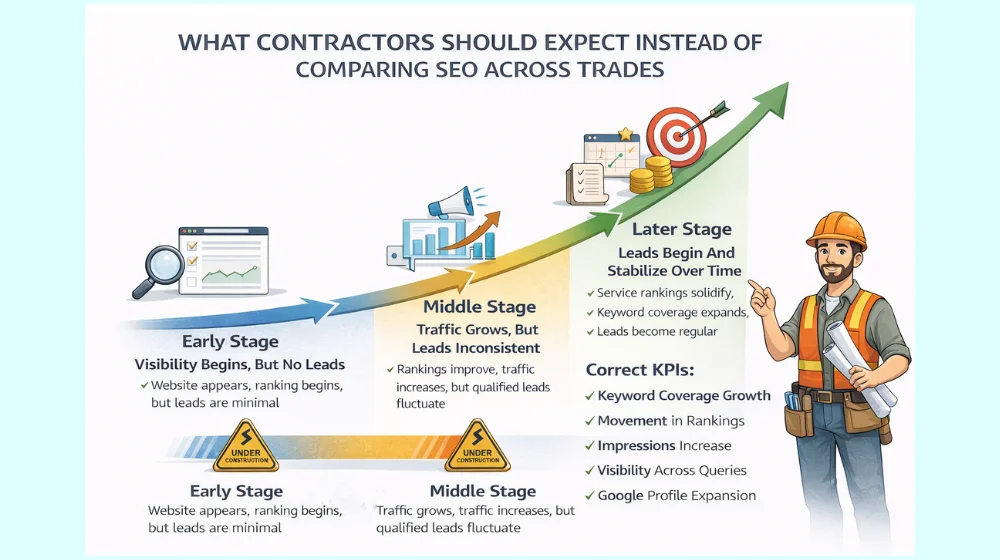
Comparing SEO timelines across trades creates the wrong expectations. A plumbing company seeing results in three months and a foundation repair company taking nine months are not experiencing different outcomes—they are operating under different conditions.
The better approach is to align expectations with how foundation repair SEO actually progresses.
Instead of asking “Why is this slower than other trades?”, contractors should focus on what stage their SEO is currently in and whether it is progressing correctly.
A realistic progression looks like this:
- Early stage: visibility begins, but no leads. Your website starts appearing in search results. Impressions increase. Rankings are low, but Google is recognizing your presence.
- Middle stage: traffic grows, but leads are inconsistent. You begin attracting users researching foundation problems, costs, and solutions. Engagement improves, but high-intent rankings are still developing.
- Later stage: leads begin and stabilize over time. Your site starts ranking for service-driven searches. Visibility expands across multiple keywords, and inquiries become more consistent.
This progression is normal in foundation repair SEO, especially in competitive cities like Dallas and Houston.
Another important shift is how success is measured.
Instead of focusing only on:
- Immediate calls
- Top rankings for a single keyword
contractors should track:
- Growth in keyword coverage
- Movement across multiple search queries
- Increase in impressions and visibility
- Expansion of local presence through Google Business Profile
These signals show whether SEO is progressing, even before leads become consistent.
It is also important to understand that consistency comes from coverage, not a single ranking. Relying on one keyword like “foundation repair near me” creates instability. Strong performance comes from ranking across:
- Multiple service variations
- Location-based searches
- Cost and comparison queries
This creates a more stable flow of traffic and leads.
Another expectation to reset is timing.
In faster trades, results can appear quickly because user behavior and competition allow it. In foundation repair, progress is tied to:
- Building authority
- Strengthening trust signals
- Competing against established businesses
This naturally extends the timeline.
What this means is that SEO should not be judged by how fast it works compared to other trades. It should be evaluated by whether it is building toward consistent, qualified lead generation over time.
When expectations align with reality, decisions improve. Contractors are less likely to stop early, change strategies too soon, or misinterpret normal progress as failure.
The goal is not speed—it is sustainable visibility and predictable lead flow in a highly competitive trade.
What Most Contractors Get Wrong When Comparing SEO Across Trades
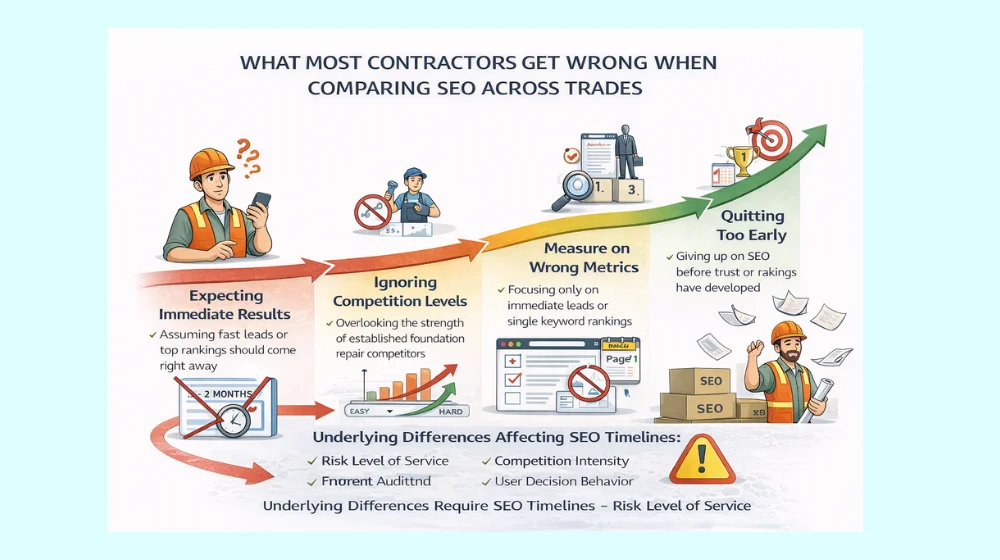
The biggest mistake contractors make is assuming that SEO follows a universal timeline. They see results from plumbers, roofers, or HVAC companies and expect the same pace—without accounting for how different the underlying conditions are.
This leads to incorrect conclusions early in the process.
One of the most common errors is expecting speed instead of progression. Contractors often look for immediate calls or top rankings within the first few months. When that does not happen, they assume SEO is underperforming. In reality, foundation repair SEO is still in the phase where Google is building trust and evaluating authority.
Another mistake is comparing outcomes without comparing competition levels. A plumbing company may rank quickly because:
- Competition is fragmented across many services
- Entry barriers are lower
- Trust thresholds are less strict
In foundation repair, especially in cities like Dallas and Houston, competitors have often invested in SEO for years. Expecting to match that authority in a short period creates unrealistic expectations.
There is also a tendency to focus on the wrong stage of results. Contractors often measure success based on:
- Immediate leads
- Ranking for one primary keyword
But these are late-stage outcomes. Early SEO progress shows up as:
- Increased impressions
- Movement across multiple keywords
- Growth in content coverage
Ignoring these signals leads to premature changes in strategy.
Another issue is overlooking user behavior differences. In faster trades, users act quickly, which produces strong engagement signals early. In foundation repair, users take longer to research and decide. This delay affects:
- Conversion timing
- Engagement patterns
- Ranking acceleration
Comparing these two behaviors directly leads to confusion.
Many contractors also underestimate the importance of combined signals. They may focus only on their website while ignoring their Google Business Profile, or vice versa. In foundation repair, both must grow together to generate consistent results.
Finally, a critical mistake is quitting too early. Most contractors reassess SEO between months three and six—the exact period when:
- Rankings begin to move
- Visibility starts to increase
- Trust is still building
Stopping at this stage resets progress and reinforces the misconception that SEO “does not work.”
What separates successful contractors is not just investment—it is alignment with how the process actually works in their trade.
SEO timelines are not slow or fast in isolation. They are shaped by:
- Risk level of the service
- Competition intensity
- User decision behavior
Foundation repair sits at the higher end of all three.
When contractors understand this, they stop comparing timelines—and start building strategies that match the realities of their market.
Frequently Asked Questions About Why Foundation Repair SEO Takes Longer
Why does foundation repair SEO require more time than other trades?
Because it involves higher risk, higher cost, and more complex decision-making. Google requires stronger trust signals before ranking businesses, and homeowners take longer to evaluate options before hiring.
Why do plumbers and HVAC companies rank faster?
These trades are driven by urgency. Users search, click, and call quickly, which creates strong engagement signals early. This allows Google to promote rankings faster compared to foundation repair.
Does higher cost affect SEO timelines in foundation repair?
Yes. Higher ticket services require more trust before users take action. This delays conversions and signals to Google that decisions take longer, which slows ranking progression.
Can a new foundation repair company compete with established competitors?
Yes, but it takes time. New websites must build:
Topical authority through content
Local trust through reviews
External authority through backlinks
In competitive markets like Austin, this process takes longer because competitors already have strong foundations.
Is SEO still worth it for foundation repair contractors?
Yes. Although it takes longer to build, SEO becomes one of the most stable and scalable lead sources once rankings and authority are established.
What is the biggest mistake contractors make with SEO timelines?
Comparing their results to other trades. Foundation repair operates under different conditions, so timelines should be evaluated based on progression within the trade—not against unrelated industries.
