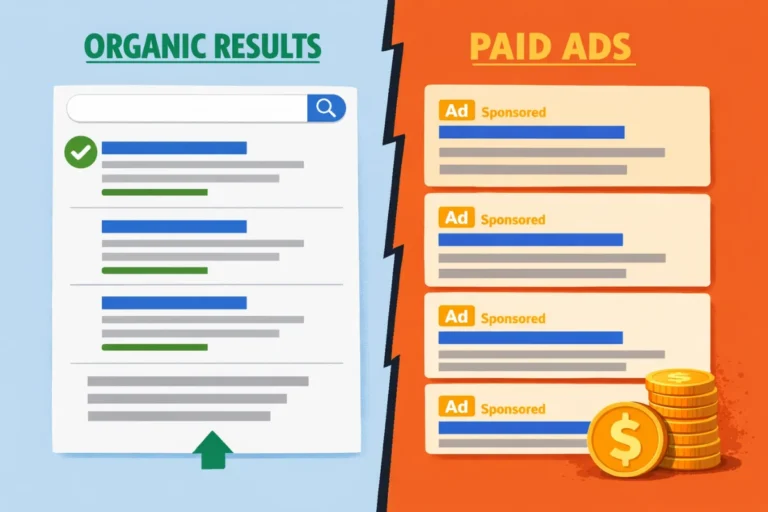


SEO is often presented as a universal solution for contractor growth. The assumption is simple: if a contractor invests in SEO, visibility will increase, leads will follow, and business will improve. When this doesn’t happen, the conclusion is usually that SEO failed—or that it never worked in the first place.
In reality, SEO does not behave the same way for every contractor. Its effectiveness depends on search demand, service type, market conditions, and how homeowners actually look for that kind of work. In some situations, SEO performs exceptionally well. In others, it underperforms or produces little meaningful impact—not because it was done poorly, but because the fit was wrong.
This article examines does SEO work for contractors by defining its boundaries. Instead of assuming SEO should work everywhere, it explains when SEO aligns with contractor business models, when it doesn’t, and why many so-called SEO failures are actually cases of misalignment rather than broken strategy.
Table of Contents
Does SEO Work for Contractors in Every Trade?
SEO does not work equally well for every contractor trade because search behavior varies by service type. Some trades are naturally searched for, compared, and chosen online, while others rely more heavily on referrals, long-term relationships, or institutional bidding. SEO performs best where homeowners actively search and evaluate options digitally.
Trades tied to urgent, visible, or recurring problems tend to align well with SEO. When homeowners can easily identify an issue and search for help, SEO creates clear entry points. In contrast, highly specialized or referral-driven trades may see limited organic demand, reducing SEO’s impact regardless of execution quality.
Another factor is decision ownership. If the person searching is also the decision-maker, SEO can influence outcomes directly. When decisions are made by committees, property managers, or procurement systems, search plays a smaller role. SEO may still create awareness, but it rarely drives conversion on its own.
Because of these differences, asking whether SEO works for all contractors oversimplifies the issue. SEO works best where search behavior, decision authority, and service visibility intersect. Where those conditions are absent, limited results reflect structural fit—not failure.
When Does SEO Work Well for Contractors?
SEO works well for contractors when there is clear, repeatable search demand tied to problems homeowners recognize and actively try to solve online. When people know what they need, can describe it in search terms, and are comparing providers, SEO becomes a reliable way to enter the decision process early.
Another condition is market visibility opportunity. SEO performs best when multiple contractors compete openly in search results and homeowners expect to choose among them. In these environments, search engines act as matchmakers, surfacing businesses that appear relevant, credible, and locally available. SEO reinforces presence across that comparison window rather than relying on a single moment.
SEO also works well when the searcher and buyer are the same person. Residential services often meet this condition, because the homeowner searching is also approving the work. This alignment allows SEO visibility to influence real outcomes directly instead of stopping at awareness.
When these factors align, SEO compounds over time. Visibility builds familiarity, familiarity builds trust, and trust supports conversion. In these scenarios, SEO does not feel experimental—it feels predictable. That predictability comes from fit, not from tactics.
Why SEO Doesn’t Work for Some Contractors
SEO doesn’t work for some contractors because search is not part of how their buyers choose providers. When demand is driven by referrals, long-standing relationships, or institutional processes, organic search plays a limited role. In these cases, SEO can increase visibility without influencing decisions.
Another reason SEO underperforms is low or fragmented search demand. Some contractor services are too niche, too specialized, or too infrequently searched to sustain meaningful organic visibility. Even perfect SEO execution cannot create demand where homeowners rarely search or lack the language to describe the service.
SEO also struggles when decision authority is separated from the searcher. If the person researching is not the person approving the work, SEO’s influence stops early. Visibility may inform awareness, but it does not translate into leads or jobs without downstream alignment.
These scenarios are often mislabeled as SEO failure. In reality, they represent structural mismatch, not poor performance. Understanding why SEO doesn’t work in these contexts helps contractors avoid chasing solutions that were never designed for their business model.
How Search Demand Determines Whether SEO Works for Contractors
Search demand determines whether SEO works for contractors because SEO amplifies existing behavior; it does not invent it. Search demand (how often homeowners actively look for a service using search engines) sets the ceiling for what SEO can realistically deliver. When demand is present and consistent, SEO can channel it. When demand is thin or sporadic, results plateau quickly.
Demand quality matters as much as demand volume. Queries that signal clear intent—problem recognition, urgency, or comparison—create opportunities for SEO to influence decisions. Vague or infrequent searches generate impressions without outcomes, which can make SEO appear ineffective even when visibility improves.
Geography also shapes demand. In some areas, homeowners default to search when evaluating contractors; in others, word-of-mouth dominates. SEO performs best where search is a habitual starting point. Where it isn’t, visibility may rise without producing meaningful engagement.
Because of this, SEO success is bounded by how people actually look for help. When contractors evaluate SEO without first understanding demand patterns, they risk mistaking low demand for poor execution. SEO works when it aligns with how buyers already behave—not when it tries to change them.
Why Market Maturity Affects Contractor SEO Outcomes
Market maturity affects contractor SEO outcomes because search engines reward established patterns of comparison and choice. A mature market (one where many contractors actively compete and homeowners expect to choose among them online) creates fertile ground for SEO. In these markets, search behavior is normalized, and visibility directly influences selection.
In less mature markets, homeowners may rely more on personal networks, builders, or long-standing vendors. Even when contractors appear in search results, visibility does not carry the same decision weight. SEO may increase awareness without translating into measurable leads, not because it is ineffective, but because search is not yet the primary decision channel.
Market maturity also influences competitive pressure. In mature markets, SEO visibility is continuously tested, refined, and rewarded based on engagement. In less developed markets, fewer signals exist for search engines to evaluate, slowing feedback loops and making performance harder to interpret.
This explains why the same SEO approach can succeed in one environment and underperform in another. Contractor SEO works best where search has already become the default comparison mechanism. Where that maturity is missing, results reflect market structure—not SEO quality.
When Contractor Business Models Limit SEO Effectiveness
Contractor business models can limit SEO effectiveness when jobs are not acquired through open-market selection. SEO performs best when homeowners independently search, compare, and choose providers. When work is secured through closed systems, search visibility has limited influence on outcomes.
Referral-heavy models are one example. Contractors who rely primarily on builders, property managers, insurance programs, or long-standing commercial relationships may see minimal return from SEO. Even if visibility improves, decision-making happens offline or upstream, outside the search environment.
Another limiting model is capacity-constrained operations. Contractors who intentionally limit volume, specialize narrowly, or only take selective projects may not convert increased visibility into measurable growth. SEO can still increase awareness, but it may not align with how the business accepts work.
These limitations do not mean SEO is broken. They mean SEO is not the primary growth lever for that model. When contractors expect SEO to override structural constraints, disappointment follows. Understanding these limits clarifies when SEO should play a supporting role rather than a central one.
Why SEO Failure Doesn’t Always Mean SEO Is Broken
SEO failure is often assumed when results don’t match expectations, but lack of results does not automatically indicate a broken system. In many contractor cases, SEO is functioning as designed—surfacing visibility where demand, behavior, and market structure allow—while outcomes fall short due to misalignment, not malfunction.
One common issue is expectation mismatch. Contractors may expect SEO to generate immediate leads in environments where decisions are slow, demand is thin, or search is not the primary buying channel. When SEO performs its role—creating awareness and presence—but conversions lag, it is labeled a failure instead of a signal about fit.
Another factor is misattribution. SEO often influences decisions indirectly, especially in longer or referral-assisted cycles. When final conversions occur through direct contact, referrals, or offline conversations, SEO’s contribution is invisible. This creates the illusion that SEO “did nothing,” even though it shaped consideration earlier.
Understanding this distinction reframes performance evaluation. SEO is not a universal solution, but it is also rarely broken in isolation. When results fall short, the more accurate question is not “Did SEO fail?” but “Was SEO the right lever for this business, in this market, at this time?”
Why Contractors Often Misunderstand Whether SEO Works
Contractors often misunderstand whether SEO works because they evaluate it as a universal solution instead of a fit-dependent system. SEO responds to demand, behavior, and market structure, but expectations are usually shaped by success stories from very different trades or environments. When outcomes differ, SEO is blamed instead of reassessed.
Does SEO work for contractors in every situation?
SEO does not work for contractors in every situation. It performs best when homeowners actively search, compare options, and make decisions online. When those conditions are absent, SEO may increase visibility without influencing outcomes.
Why does SEO work for some contractors but not others?
SEO works for some contractors and not others because search behavior varies by trade, market maturity, and buyer decision process. Contractors serving high-search, comparison-driven services see clearer results than those operating in referral-dominant or closed systems.
When should contractors avoid relying on SEO?
Contractors should avoid relying on SEO when demand is minimal, decisions are controlled by third parties, or work is secured through long-term relationships rather than open search. In these cases, SEO may play a supporting role but rarely drives primary growth.
How can contractors tell if SEO will work for them?
Contractors can assess SEO viability by examining how customers currently find them. If search already plays a role in discovery or comparison, SEO is likely to contribute meaningfully. If not, limited results reflect fit—not failure.
What “Does SEO Work for Contractors?” Really Means
The question of whether SEO works for contractors is really a question of alignment. SEO amplifies existing search behavior; it does not create it. When demand, decision-making, and market structure support search-driven selection, SEO becomes a powerful growth channel.
When those conditions are missing, SEO does not stop functioning—it simply stops being decisive. Visibility may increase without translating into jobs, leading to frustration and misinterpretation. Understanding this distinction prevents contractors from dismissing SEO entirely or expecting it to solve problems it was never designed to address.
When evaluated correctly, SEO is neither a guarantee nor a gamble. It is a system that works well under the right conditions and underperforms when misapplied. For contractors, clarity about those boundaries is what turns confusion into informed decision-making.