
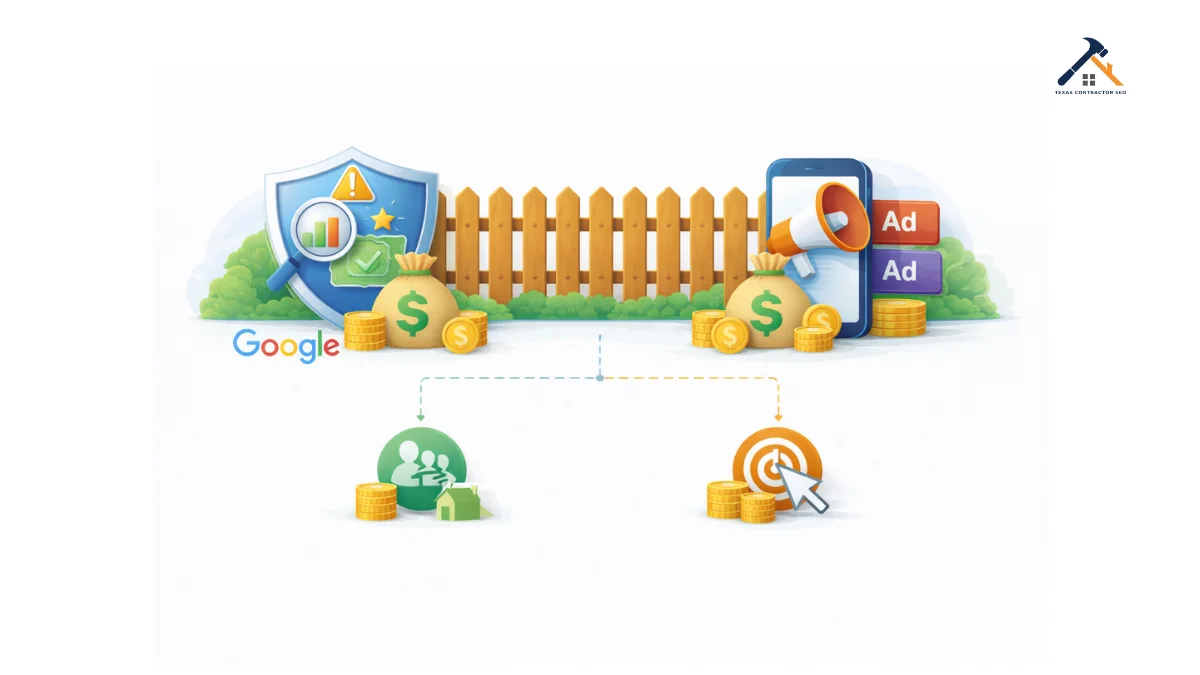

Fence leads do not behave uniformly across acquisition channels. SEO leads, referral leads, and paid advertising leads originate from different lead systems, each governed by how demand is created, discovered, or activated.
SEO leads emerge from ongoing search behavior tied to problem recognition and comparison. Referral leads arise through trust transferred from prior customers or professional networks. Paid advertising leads are generated through visibility and interruption rather than self-directed intent.
These structural differences shape trust at first contact, timing to outreach, and lead stability over time. This article analyzes how fence leads from SEO, referrals, and ads behave as distinct systems, explaining why each produces predictable patterns in readiness, volume consistency, and long-term reliability.
How do SEO, referral, and paid ad fence leads differ in trust at first contact?
SEO fence leads arrive with self-directed trust. The buyer has actively searched, compared options, and chosen to initiate contact, which creates baseline confidence before the conversation begins. Trust is earned through visibility, content relevance, and perceived legitimacy rather than personal connection.
Referral fence leads inherit trust from the source. A prior customer, neighbor, or contractor transfers credibility directly, allowing the conversation to start at a higher trust level with fewer questions or objections.
Paid advertising fence leads start with conditional trust. The lead responds to interruption rather than intent, so confidence is provisional and easily withdrawn if expectations are not immediately met.
These differences shape early conversations. SEO leads validate fit, referral leads confirm availability, and ad leads test credibility quickly. Trust formation therefore depends on how the lead was generated, not just what service is being offered.
Why do fence leads from SEO behave differently in timing than referrals and ads?
Fence leads from SEO follow a discovery-based timeline because buyers initiate contact only after clarifying need, scope, and options. Search activity often precedes outreach by days or weeks as homeowners and property managers evaluate alternatives before committing to contact.
Referral fence leads bypass this discovery phase. Trust is transferred at the moment of recommendation, allowing buyers to reach out immediately without extended evaluation or comparison.
Paid advertising fence leads operate on a trigger-based timeline. Ads prompt immediate response, regardless of whether the fencing need has fully matured. This accelerates contact but decouples timing from problem definition.
These differences create distinct timing patterns. SEO leads arrive later but with resolved intent, referrals arrive quickly when social conditions align, and ads generate instant responses driven by exposure rather than readiness.
How does lead volume stability differ between SEO, referrals, and advertising?
Lead volume stability differs because each fence lead source is tied to a different demand engine. SEO leads regenerate from active search behavior, referral leads depend on past job momentum, and advertising leads exist only while exposure is applied. These structural differences determine whether lead flow compounds, fluctuates, or collapses.
SEO fence leads stabilize over time because they originate from ongoing problem discovery. Homeowners and property managers continue to search for fencing solutions regardless of any single contractor’s activity. As organic visibility persists, lead flow becomes repeatable and forecastable, even though individual inquiries arrive at uneven intervals.
Referral fence leads lack this regenerative base. They appear only when previous customers remember, recommend, or encounter someone with a fencing need. Volume rises after busy installation periods and falls during slower cycles, creating dependency on past work rather than current demand.
Advertising-driven fence leads are the least stable because they are externally activated. Lead flow increases when ads are live and stops when exposure ends. This produces sharp spikes that are disconnected from organic demand patterns.
Volume stability therefore reflects how demand is accessed. SEO aligns with persistent market demand, referrals rely on social recall, and ads create temporary attention. These systems behave differently because they are built on different sources of continuity, not because of execution quality.
Why do referral-based fence leads remain high quality but low scale?
Referral-based fence leads remain high quality because trust is transferred before contact occurs. A recommendation from a past customer, neighbor, or industry peer establishes credibility in advance, reducing skepticism and shortening qualification.
That same trust mechanism limits scale. Referrals require three conditions to align simultaneously: a satisfied prior customer, an active social connection, and a current fencing need within that network. If any element is missing, no lead is generated.
Referral volume is therefore tied to historical activity rather than present demand. Strong installation periods increase future referrals, while slower cycles reduce them regardless of how many people are actively searching for fencing services.
This dependency creates episodic flow. Referrals arrive in clusters rather than steady streams, reflecting social timing instead of market size. High quality persists because trust is inherited, while low scale persists because referrals cannot regenerate independently.
How do paid ad fence leads differ in intent consistency compared to SEO leads?
Paid ad fence leads differ from SEO leads in intent consistency because they originate from exposure rather than deliberate search. The buyer responds to an advertisement at a specific moment, which means readiness varies widely depending on context, urgency, and distraction.
SEO fence leads originate from intentional search behavior. The buyer initiates contact only after recognizing a fencing need and actively seeking solutions. This self-selection filters uncertainty before outreach, producing more consistent intent across inquiries.
Paid advertising compresses evaluation into a single moment. Some responses come from buyers ready to proceed, while others reflect curiosity or convenience without resolved scope or timing.
Intent variance is therefore structural. SEO leads reflect intent shaped by problem definition, while ad leads reflect intent shaped by momentary attention. This difference persists regardless of campaign quality or messaging.
Fence lead sources differ by how demand is created, not just how it is captured
Fence leads behave differently because SEO, referrals, and ads originate from fundamentally different demand creation mechanisms. These origins determine trust formation, timing, stability, and how conversations begin long before any contractor interaction occurs.
Why do SEO fence leads originate from problem discovery?
SEO fence leads form when buyers recognize a fencing need and actively search for solutions. The demand already exists before contact, and search acts as a discovery channel rather than a trigger. This produces leads shaped by self-directed intent and prior evaluation.
Why do referral fence leads originate from trust inheritance?
Referral fence leads emerge when trust is transferred through social or professional networks. The demand may be immediate or dormant, but credibility is preloaded from the source, allowing contact to occur without independent verification or comparison.
Why do paid fence leads originate from interruption?
Paid fence leads are generated by visibility rather than intent. Advertising interrupts attention and prompts response even when the fencing need is not fully formed, creating leads that vary widely in readiness and urgency.
How does lead origin affect the first sales conversation?
Lead origin shapes the opening dialogue. SEO leads ask validation questions, referral leads confirm availability, and ad leads test credibility quickly. Each conversation begins at a different trust and readiness baseline.
Why do mixed fence lead sources behave unpredictably together?
Combining lead sources introduces conflicting demand signals. Stable SEO leads, episodic referrals, and volatile ad leads create uneven pipelines because they regenerate through incompatible mechanisms rather than a shared demand cycle.
How fence lead systems mature differently over time
Fence lead systems diverge as they mature because they are anchored to different renewal forces. SEO-based demand compounds as long-term visibility aligns with ongoing search behavior, creating a lead stream that persists independently of recent job volume or active promotion.
Referral-based demand matures through past performance rather than present visibility. Its strength depends on accumulated reputation and social recall, which produces high-quality leads but limits regeneration speed and scale as markets grow.
Advertising-based demand does not mature in the same sense. It remains reactive, restarting each time exposure is applied and stopping when it is removed. Lead flow resets rather than compounds, keeping performance tied to activation cycles.
Over time, these systems do not converge. They continue to behave according to how demand is discovered, transferred, or interrupted. Fence lead performance is therefore shaped less by execution choices and more by the structural mechanics of how each channel creates demand in the first place.