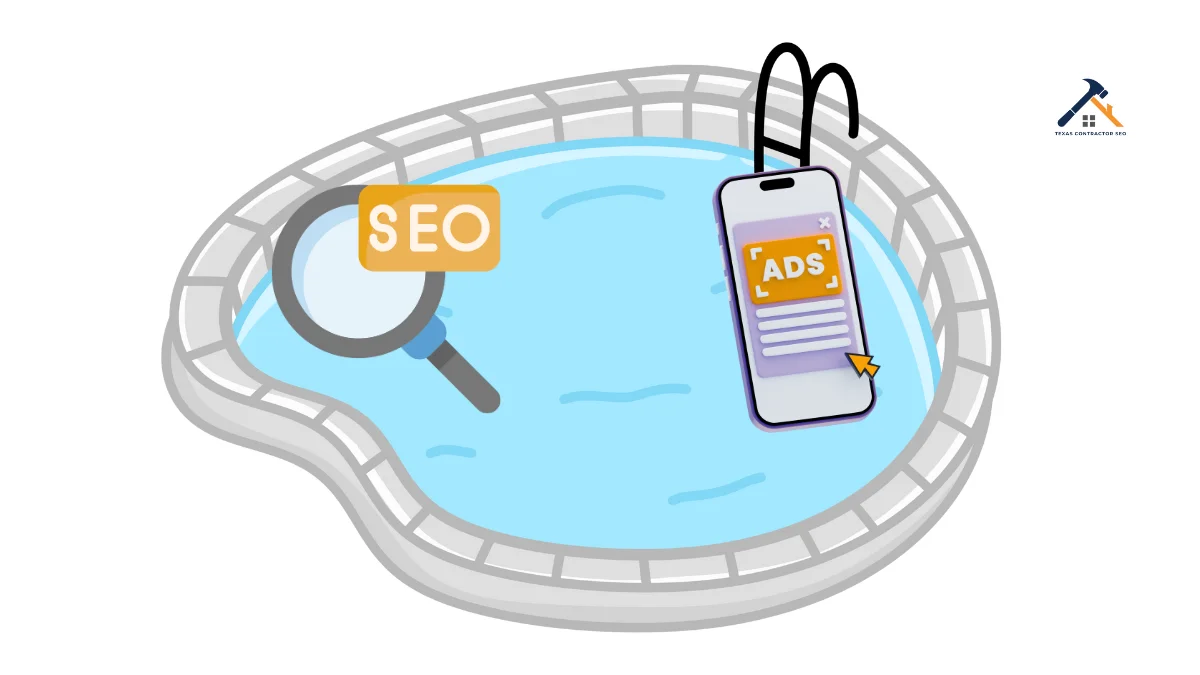

Pool builders acquire customers through two fundamentally different demand systems: organic search visibility and paid distribution channels. While both can generate inquiries, they operate under different cost structures, intent signals, and risk profiles—especially for high-ticket custom pool projects.
SEO captures demand from homeowners actively researching pool construction, design, and builder credibility. Paid ads—including Google Ads, social media ads, lead aggregators, and referral-driven promotion—inject visibility by placing offers in front of audiences who may or may not be ready to build. These differences affect lead quality, sales timelines, and long-term scalability.
For pool builders operating in competitive markets, the decision is not about traffic volume but about ownership, trust, and cost stability. This article compares pool builder SEO and paid ads by analyzing how each channel generates leads, how buyers behave within them, and which models align best with high-ticket construction economics.
What Are the Main Customer Acquisition Channels for Pool Builders?
Pool builders acquire customers through owned, rented, and relational demand channels, each producing leads under different levels of control, cost stability, and buyer intent. These channels behave very differently for high-ticket custom pool projects.
Owned channels are led by SEO. Visibility is earned through organic search and local discovery when homeowners actively research pool design, costs, and builders. Leads arrive directly to the builder, without intermediaries, and compound over time as authority grows.
Rented channels include paid ads such as Google Ads, social media ads, and lead aggregators. These channels buy attention rather than earning it. Lead flow exists only while spend continues, and demand is often shared, interrupted, or price-sensitive.
Relational channels include referrals and word-of-mouth. While high in trust, they are inconsistent and not scalable on their own. They supplement demand but rarely provide predictable pipeline growth.
For pool builders, understanding these acquisition models is critical because high-ticket buyers require trust, time, and validation. The channel used determines not just how leads arrive, but how ready those leads are to commit.
How Does Pool Builder SEO Generate Leads?
Pool builder SEO generates leads by capturing active homeowner demand during long, high-consideration research cycles. Homeowners search with intent to learn, compare, and validate before contacting a builder, and SEO positions a pool builder where those decisions are forming.
Organic visibility aligns with pre-, mid-, and late-stage queries. Early searches focus on ideas and feasibility, mid-stage searches evaluate design options, costs, and timelines, and late-stage searches validate builders through reviews, portfolios, and process explanations. SEO earns trust across these stages, not just clicks.
SEO leads are exclusive and self-selected. Homeowners choose a specific builder after evaluating credibility signals—project galleries, expertise, local relevance—before initiating contact. This pre-qualification increases alignment and reduces price-driven competition.
For high-ticket custom pools, SEO compounds. As authority and engagement grow, visibility expands across stages of intent, producing fewer but higher-quality inquiries that mature into contracts over time—without resetting costs each month.
How Do Paid Ads Generate Pool Builder Leads?
Paid ads generate pool builder leads by buying immediate visibility, not by earning long-term relevance. Platforms such as Google Ads, social media ads, and lead aggregators place offers in front of users based on targeting rules rather than demonstrated readiness to build a custom pool.
Google Ads capture demand at the moment of search, but intent varies widely. Some users are researching casually, others are price-checking, and only a subset are ready to engage a builder. Visibility ends the moment spend stops, making lead flow directly dependent on budget.
Social media ads introduce pool concepts to users who were not actively searching. These leads are often inspiration-driven and early-stage. While useful for awareness, they require longer nurturing before they resemble decision-ready inquiries.
Lead aggregators collect demand on centralized platforms and distribute it to multiple builders. Leads are rarely exclusive, competition is immediate, and response speed often outweighs trust or design alignment.
Paid ads create speed and volume, but they do not compound authority or trust. For high-ticket pool projects, this means many inquiries arrive before buyers have completed the research and validation steps that SEO naturally filters in advance.
What Is the Cost Difference Between SEO and Paid Ads for Pool Builders?
The cost difference between SEO and paid ads for pool builders lies in how expenses scale over time and how value compounds. SEO concentrates cost upfront and during growth, while paid ads impose continuous, usage-based costs that reset each month.
With SEO, investment funds authority building—content depth, local relevance, and trust signals—that continue producing visibility after the work is done. As rankings mature, cost per qualified inquiry declines, even as lead quality improves. The spend does not increase linearly with volume once authority is established.
With paid ads, costs scale directly with exposure. Google Ads, social media ads, and lead aggregators require ongoing payments for each click, impression, or lead. In competitive markets and peak seasons, costs rise while quality often declines due to bidding pressure and shared demand.
For high-ticket pool projects, this difference is magnified. A single closed project can justify months of SEO investment, whereas paid ads require continuous spend to maintain the same lead flow, creating cost volatility and margin pressure over time.
How Do Lead Quality and Intent Differ Between SEO and Paid Ads?
Lead quality and intent differ between SEO and paid ads because the buyer’s decision state is established before contact in SEO, but after contact in paid channels. This distinction is critical for high-ticket custom pool projects.
SEO leads originate from homeowners who have already completed significant self-education. They have researched designs, cost ranges, timelines, and builder credibility before reaching out. Their intent is informed and deliberate, which shortens qualification and aligns expectations.
Paid ad leads often arrive earlier in the decision cycle. Google Ads capture mixed intent, social media ads interrupt passive users, and lead aggregators distribute inquiries before trust is formed. As a result, many paid leads require education before qualification.
For pool builders, higher intent matters more than volume. SEO produces fewer but better-aligned inquiries, while paid ads produce more contacts that must be filtered, nurtured, or disqualified—extending sales cycles and increasing acquisition effort.
How Does Buyer Trust Differ Between Organic Search and Paid Ads?
Buyer trust differs between organic search and paid ads because organic visibility is perceived as earned credibility, while paid visibility is recognized as purchased exposure. This perception gap strongly influences high-ticket pool decisions.
In organic search, trust begins before the click. Rankings, reviews, content depth, and consistent visibility signal legitimacy and experience. Buyers interpret strong organic presence as proof that a pool builder is established, vetted by others, and relevant to their needs.
Paid ads require trust to be built after the click. Homeowners know ads are bought, not earned, so credibility must be proven quickly through messaging, proof, and follow-up. Any friction—unclear pricing, weak portfolios, or inconsistent communication—slows confidence formation.
For custom pool buyers, where risk tolerance is low, organic search shortens the trust-building gap. SEO preloads credibility, while paid ads must overcome skepticism during the sales process.
How Do SEO and Paid Ads Perform for High-Ticket Pool Projects?
SEO and paid ads perform differently for high-ticket pool projects because the buyer journey is long, risk-sensitive, and comparison-heavy. Performance is not measured by click volume but by how well each channel supports extended decision-making.
SEO performs strongly across the full consideration arc. It captures buyers during early research, reinforces credibility during comparison, and remains visible during late-stage validation. This continuity supports high-ticket decisions that require multiple search sessions over weeks or months.
Paid ads perform best at demand interception, not demand development. Google Ads can capture ready-to-act searches, but social media ads and aggregators often surface interest before readiness. For high-ticket pools, this creates friction because buyers still need education, proof, and reassurance.
As project value increases, trust density matters more than speed. SEO aligns with this reality by compounding authority over time, while paid ads rely on timing and budget. For custom pools, SEO consistently produces fewer but better-aligned opportunities, while paid ads introduce variability in readiness and outcomes.
What Are the Risks of Relying on Paid Ads for Pool Builders?
Relying on paid ads introduces cost volatility, demand dependency, and intent misalignment, which are amplified in high-ticket pool construction. Because paid visibility is rented, lead flow exists only while budgets are active, creating immediate risk when spend pauses or competition increases.
Paid ads expose pool builders to pricing pressure and auction dynamics. In competitive periods, costs rise quickly, while lead quality can decline as ads are shown to broader or less-ready audiences. This erodes margins and increases time spent qualifying inquiries.
There is also trust and readiness risk. Many paid leads arrive before buyers have completed research, forcing builders to educate, nurture, or disqualify prospects. This extends sales cycles and strains follow-up capacity.
For high-ticket projects, these risks compound. Without an owned demand channel like SEO, pool builders face unpredictable pipelines and limited long-term leverage, making growth dependent on continuous ad spend rather than accumulated authority.
Where Do Lead Aggregators and Referral Marketing Fit in This Comparison?
Lead aggregators and referral marketing sit outside the SEO vs paid ads spectrum, but they influence how pool builders evaluate acquisition risk, control, and scalability. Neither operates as a fully owned demand channel.
Lead aggregators function as a paid distribution layer. They centralize demand and resell access to multiple builders, often simultaneously. For high-ticket pool projects, this model introduces immediate competition, compresses trust-building time, and shifts selection toward speed or price rather than design fit and credibility.
Referral marketing operates on trust but lacks predictability. Referrals are high-quality when they occur, yet they cannot be scaled or forecasted. Volume fluctuates based on past client behavior, not market demand or strategic control.
In this comparison, aggregators provide short-term volume with dependency risk, referrals provide quality without consistency, and SEO provides controllable, compounding visibility. Pool builders often use referrals and aggregators as supplements, but neither replaces the structural stability of owned search demand.
Which Acquisition Model Is Most Sustainable for Pool Builders?
SEO is the most sustainable acquisition model for pool builders because it creates owned demand, compounding visibility, and stable intent alignment for high-ticket projects. Once authority is established, SEO continues to generate qualified inquiries without proportional increases in spend.
Paid ads, lead aggregators, and referrals each play supporting roles, but none compound. Paid ads reset monthly, aggregators introduce dependency and shared competition, and referrals fluctuate unpredictably. These channels can supplement volume, but they do not replace durable demand ownership.
For custom and luxury pools—where buyers require time, proof, and trust—sustainability depends on being discoverable throughout the entire research-to-decision cycle. SEO supports this continuity by aligning with how buyers actually search and decide.
The most resilient growth model prioritizes SEO as the foundation, then layers paid ads, referrals, and aggregators tactically—without surrendering control of visibility or long-term cost stability.
What factors influence how pool builders evaluate acquisition channels over time?
Pool builders evaluate acquisition channels based on more than short-term lead volume. Project value, sales cycle length, trust requirements, and cost predictability all influence how SEO, paid ads, referrals, and aggregators are weighed as part of a long-term growth strategy.
Do Paid Ads Work Better Than SEO for Immediate Pool Leads?
Paid ads can generate faster inquiries, but speed does not equal readiness. For high-ticket pools, immediate leads often require extensive education and nurturing, while SEO produces slower but better-aligned inquiries that convert with less friction.
Are Google Ads Effective for Custom Pool Projects?
Google Ads can be effective for capturing late-stage demand, but performance varies by competition and budget. Without strong trust signals, ads often attract price-checkers rather than committed buyers, limiting efficiency for custom projects.
Do Social Media Ads Generate Serious Pool Buyers?
Social media ads are effective for inspiration and awareness but rarely produce decision-ready buyers. Most inquiries arrive early in the planning phase and require long nurturing cycles before they resemble qualified pool leads.
Can Referral Marketing Replace SEO or Paid Ads?
No. Referrals are valuable but inconsistent. They depend on past client behavior and cannot be scaled or forecasted. Referral marketing complements acquisition but cannot replace structured demand generation.
What Happens When Pool Builders Stop Running Ads?
Lead flow stops immediately. No residual visibility or authority remains once ad spend pauses. This exposes builders to pipeline instability if ads are their primary acquisition channel.
How Pool Builders Should Evaluate SEO and Paid Ads Over Time
SEO and paid advertising serve different roles in how pool builders acquire demand. SEO captures buyer intent as it develops, supporting long-cycle research, trust-building, and comparative evaluation, while paid ads introduce visibility through budget-driven exposure rather than accumulated authority.
Differences between the two channels extend beyond cost per lead. SEO emphasizes predictability and compounding visibility, whereas paid ads trade immediacy for volatility and dependency on continuous spend. These structural differences affect lead pacing, sales efficiency, and risk tolerance over time.
Evaluating SEO and paid ads through the lens of project value, decision timelines, and cost stability clarifies why no single channel performs optimally in isolation. Pool builders achieve more resilient acquisition systems when channel selection reflects how buyers decide rather than how traffic is purchased.