

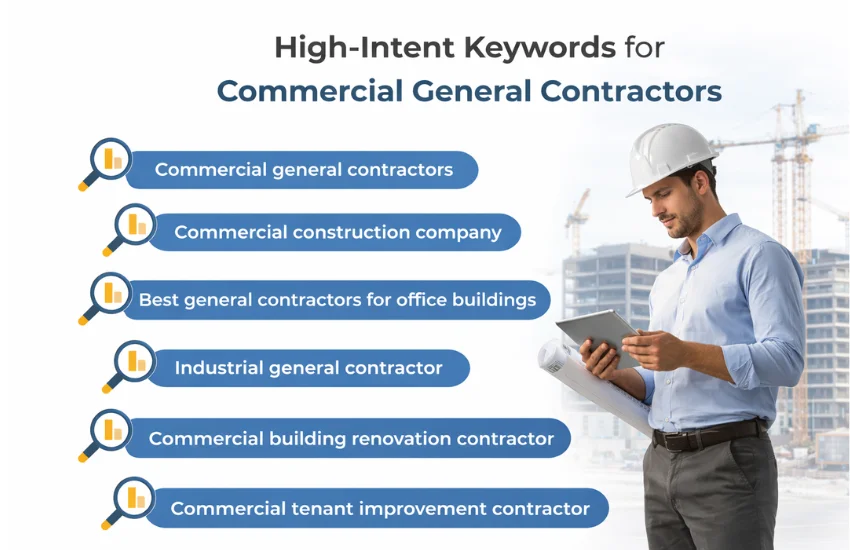
High intent keywords for commercial general contractors reflect hiring readiness rather than general interest. These searches are shaped by procurement processes, project scope, delivery models, and compliance requirements that differ from residential construction behavior.
Commercial buyers search with specific objectives. Queries often reference project type, contract structure, location coverage, and qualification criteria, signaling movement from research toward vendor evaluation or bid preparation.
This article explains how high-intent commercial construction keywords appear in search, which modifiers and project terms indicate readiness to hire, and how intent differs across commercial buyer roles and decision stages.
What makes a keyword high-intent for commercial general contractors?
A high-intent keyword for commercial general contractors signals readiness to evaluate or hire rather than general research. These keywords reflect defined project scope, delivery expectations, and procurement-stage behavior.
High-intent commercial queries usually include service specificity, project context, or contractual language. Terms related to commercial construction types, delivery models, or compliance requirements indicate that a buyer has moved beyond exploration.
Buyer structure also matters. Commercial searches often originate from organizations, not individuals, and are tied to budgeting, approvals, or bid preparation. This shifts intent from curiosity to qualification.
Because intent is embedded in language precision, high-intent keywords are typically lower volume but higher value. Their strength lies in signaling project readiness rather than broad market interest.
How do commercial construction buyers search differently than residential homeowners?
Commercial construction buyers search differently because decisions involve organizations, budgets, and formal procurement processes. Queries are structured around qualification, capability, and compliance rather than personal urgency or convenience.
Searches are often fragmented across roles. Owners, project managers, architects, and procurement teams each search with different objectives, producing multiple intent signals over time rather than a single decisive query.
Commercial searches emphasize project type, delivery method, and experience scope. Buyers look for contractors capable of meeting regulatory, logistical, and financial requirements, not just availability.
Because intent is distributed across stages and stakeholders, commercial search behavior appears less frequent but more deliberate, with each query carrying higher qualification weight than residential searches.
Which keyword modifiers indicate hiring intent for commercial general contractors?
Keyword modifiers indicate hiring intent when they narrow searches to qualified commercial services rather than general construction information. These modifiers signal that a buyer is evaluating vendors, not learning about construction concepts.
Commercial intent modifiers often include “commercial”, “industrial”, “build-out”, “tenant improvement”, and “design-build.” These terms define scope and delivery expectations, filtering out residential or DIY-focused results.
Operational modifiers also matter. Phrases related to compliance, licensing, bonding, or insured contractors reflect late-stage evaluation, where qualification and risk management are primary concerns.
When modifiers specify both service type and commercial context, they strongly indicate readiness to shortlist or initiate contact, making them more valuable than broader, higher-volume terms.
How do project type keywords signal commercial hiring readiness?
Project type keywords signal hiring readiness by defining the environment, scale, and functional requirements of a commercial build. These terms indicate that a buyer has a specific project in scope rather than a general interest in construction services.
Keywords referencing office build-outs, retail construction, warehouse facilities, healthcare projects, or hospitality developments reflect advanced planning. Buyers using these terms are often evaluating contractors with relevant experience.
Project type specificity reduces ambiguity. It signals that feasibility, compliance, and execution capability are being assessed, which typically occurs after budget alignment and internal approvals.
Because these keywords align closely with active project planning, they are strong indicators of commercial hiring intent despite lower overall search volume.
How do location and service-area keywords work for commercial contractors?
Location and service-area keywords work differently for commercial contractors because projects are often regional rather than proximity-based. Buyers search for coverage capability instead of immediate physical closeness.
Commercial queries commonly reference cities, metro regions, or multi-city coverage rather than neighborhoods. This reflects how commercial projects are planned across broader geographic footprints.
Service-area language also signals qualification. Phrases that imply regional operations or statewide service indicate buyers evaluating contractors capable of managing logistics, compliance, and coordination across larger areas.
Because geographic intent is broader, these keywords emphasize capability and reach over distance, aligning with how commercial construction decisions are made.
What role do contract and delivery-model keywords play in intent qualification?
Contract and delivery-model keywords play a critical role in intent qualification by signaling how a commercial project will be executed and managed. These terms indicate that buyers are aligning construction partners with specific procurement and risk frameworks.
Keywords such as design-build, construction management at risk, EPC, or general contracting services reflect advanced planning. Buyers using these terms are evaluating contractors based on delivery capability rather than general availability.
Delivery-model specificity reduces uncertainty. It implies that project structure, responsibility allocation, and decision authority have already been defined, which typically occurs late in the buyer journey.
Because these keywords correspond to formal procurement stages, they strongly indicate readiness to shortlist or initiate bid discussions.
How do budget, timeline, and compliance keywords signal late-stage intent?
Budget, timeline, and compliance keywords signal late-stage intent because they reflect constraints that are addressed only after project approval and planning. These terms indicate buyers are preparing to select or formally engage a contractor.
Keywords referencing cost ranges, bids, RFPs, or project timelines suggest internal alignment around scope and funding. Buyers using this language are often comparing qualified vendors rather than exploring options.
Compliance-related terms such as licensed, bonded, insured, or code-compliant indicate risk evaluation and due diligence. These requirements surface when procurement moves toward contract readiness.
Because these keywords appear late in the decision process, they are lower volume but highly qualified, often preceding direct outreach, bid requests, or shortlisting activities.
High-Intent Keyword Taxonomy for Commercial General Contractors
| Project Type | Intent Modifier | Intent Stage | What the Buyer Is Signaling |
| Office Construction | commercial office contractor | Mid-Intent | Evaluating contractors with office-specific experience |
| Office Build-Out | office tenant improvement contractor | High-Intent | Active planning for interior build-out work |
| Retail Construction | retail construction company | Mid-Intent | Comparing vendors for retail project feasibility |
| Retail Build-Out | retail tenant improvement contractor | High-Intent | Approved scope, seeking qualified execution |
| Warehouse Construction | warehouse construction contractor | Mid-Intent | Assessing large-scale industrial capability |
| Industrial Facility | industrial general contractor | Mid-Intent | Evaluating experience with complex environments |
| Healthcare Construction | healthcare construction contractor | High-Intent | Compliance-driven selection, risk-sensitive |
| Medical Office Build-Out | medical tenant improvement contractor | High-Intent | Licensed, regulated project moving toward hire |
| Hospitality Construction | hotel construction contractor | Mid-Intent | Early vendor evaluation for specialized builds |
| Hotel Renovation | hotel renovation general contractor | High-Intent | Budgeted renovation, timeline defined |
| Restaurant Build-Out | restaurant build-out contractor | High-Intent | Time-sensitive, permit-driven execution |
| Commercial Renovation | commercial renovation company | Mid-Intent | Comparing renovation specialists |
| Design-Build Project | design-build commercial contractor | High-Intent | Delivery model selected, vendor shortlisting |
| CM at Risk | construction manager at risk contractor | High-Intent | Formal procurement stage, risk allocation defined |
| EPC Construction | EPC commercial contractor | High-Intent | Large-scale, capital-intensive project |
| Commercial Contractor | licensed bonded insured contractor | Late-Stage | Final qualification and compliance check |
| Commercial Project | commercial contractor bid | Late-Stage | Active RFP or bid preparation |
| Commercial Build | commercial construction estimate | Late-Stage | Budget validation before engagement |
| Regional Construction | statewide commercial contractor | Mid-Intent | Evaluating geographic coverage capability |
| Commercial Development | experienced commercial builder | Mid-Intent | Experience validation before shortlisting |
What factors influence how commercial construction intent appears in search?
Commercial construction intent appears in search through fragmented, role-driven queries shaped by procurement structure, regulation, and project complexity. Unlike residential searches, intent is distributed across stakeholders and stages, making signals less frequent but more qualified.
How does procurement structure affect keyword phrasing?
Procurement structure shapes how searches are framed. Buyers often search using formal language tied to bids, qualifications, or delivery models rather than conversational terms, reflecting internal approval processes and structured vendor evaluation.
Why is commercial searches lower volume but higher value?
Commercial projects occur less frequently and involve fewer buyers. As a result, search volume is lower, but each query represents significantly higher project value and stronger hiring intent compared to residential construction searches.
How do industry regulations shape commercial search behavior?
Regulatory requirements introduce compliance-focused language into searches. Terms related to licensing, bonding, safety standards, or sector-specific regulations appear as buyers assess risk and eligibility before contractor engagement.
Why does commercial intent appear fragmented across multiple searches?
Commercial intent is rarely expressed in a single query. Different stakeholders search independently for project types, delivery models, credentials, and timelines, creating fragmented signals that collectively indicate readiness rather than one decisive search.
How High-Intent Keywords Reveal Commercial Hiring Readiness
High-intent keywords for commercial general contractors reflect structured decision-making rather than casual research. These searches signal defined project scope, procurement alignment, and readiness to evaluate qualified construction partners.
Commercial intent appears through specific modifiers, project types, delivery models, and compliance language. Although search volume is lower, each query carries greater qualification weight and stronger alignment with active project planning.
Understanding how these intent signals surface in search clarifies why commercial keyword strategy prioritizes precision over scale. Over time, aligning visibility with high-intent language supports more efficient lead qualification and higher-value contractor engagement.